By Nicolás Misculin
BUENOS AIRES, Feb 10 (Reuters) – Argentine President Javier Milei’s libertarian government has put sweeping labor reforms at the center of its push to attract investment and revive growth, setting up a clash with the country’s powerful unions.
The proposal, central to Milei’s effort to shift Argentina’s tightly regulated economy toward more of a free-market model, has prompted threats of mass protests from labor groups who say it would roll back workers’ rights by narrowing grounds for wrongful-dismissal claims and curbing strikes.
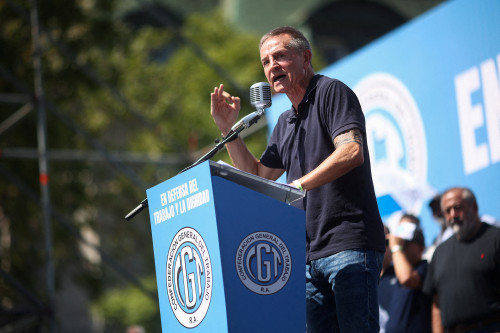
Argentina’s Senate is due to begin discussing the bill on Wednesday, with unions threatening a demonstration outside Congress that is poised to mobilize thousands of workers.
If approved, the reforms would mark a major step in Milei’s economic overhaul. A defeat would weaken his agenda and highlight the limits facing his minority government. Analysts expect the proposed legislation to advance if the government accepts changes sought by moderate opposition lawmakers.
Still, Argentina’s main unions warn unrest could escalate if the legislation clears the Senate, arguing that it curbs their authority in workplace disputes by forcing them to seek permission to hold meetings, according to Rodolfo Aguiar, head of the State Workers’ Association.
“From today onwards, the government needs to start worrying, because a new cycle is beginning in the confrontation it maintains with workers,” Aguiar said.
The reforms also could require that between 50% and 75% of services continue running during a strike for some sectors classified as essential, Aguiar said.
“The strike loses all effectiveness,” he added.
Argentina’s Interior Ministry did not respond to a request for comment.
The government defends the initiative as a “labor modernization” plan aimed at expanding formal employment in an economy where more than 40% of workers are off the books. The bill also would allow some overtime to be compensated with days off rather than extra pay.
The government has not publicly released figures estimating overall savings from the reforms.
PRIVATE-SECTOR EMPLOYMENT WOES
One of the most contentious parts of the reforms targets Argentina’s dismissal system, which for decades has offered strong protections against unfair termination and enabled courts to award substantial compensation, a process that frequently generates wrongful-dismissal claims after layoffs.
Business chambers say those lawsuits, combined with high labor taxes and rigid rules, have long discouraged hiring, particularly among small and medium‑sized firms.
“What most affects companies is the high cost of labor due to taxes and lawsuits,” said Gustavo del Boca, president of the Cordoba auto parts manufacturers’ chamber.
Supporters of the bill argue the changes are needed to spur investment and job creation.
“Labor reform is necessary in Argentina because for decades there has been almost no job creation in formal private‑sector employment,” said Aldo Abram, an analyst at the Libertad y Progreso Foundation.
Milei, who took office in late 2023 after a surprise election victory over the center‑left Peronists, has pledged to open the economy, slash public spending and reduce taxes and regulation. His fiscal tightening has helped balance state accounts and ease inflation, though economic activity remains weak and the unemployment rate stands at 6.6%.
Despite holding the largest bloc in Congress, Milei’s party lacks a majority in either chamber and has spent weeks negotiating with opposition lawmakers. The Peronist movement has openly rejected the bill.
Argentina’s unions have a long history of halting transport, blocking ports and shutting down key logistics corridors during labor conflicts, strike power that can quickly paralyze trade flows in one of the world’s top food-exporting nations.
“If our demands aren’t met, we don’t rule out an escalation of the conflict,” said Cristian Jeronimo, a leader of the CGT labor federation.
(Reporting by Nicolas Misculin; editing by Cassandra Garrison and Paul Simao)