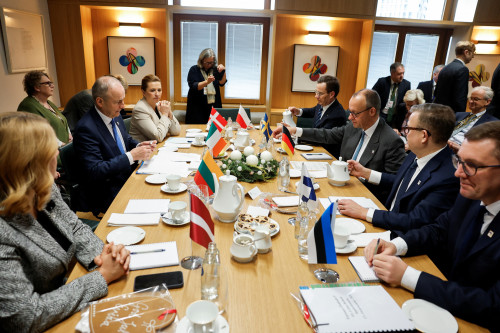
SINGAPORE/LONDON, Dec 19 (Reuters) – European Union leaders decided on Friday to borrow cash to fund Ukraine’s defence against Russia rather than use frozen Russian assets, sidestepping divisions to secure a 90 billion euro loan.
German 10-year government bonds, which serve as a benchmark for the wider euro zone market, came under modest pressure, which sent yields up 3.4 basis points on the day to 2.883%, well below Thursday’s nine-month high of 2.895%, while the euro held steady against a firmer dollar.
Here are what investors and market analysts are saying about the deal:
CARSTEN BRZESKI, GLOBAL HEAD OF MACRO RESEARCH, ING, FRANKFURT:
“I think there should be enough investor appetite for the new loan.”
“I’ve never bought the argument that this (freezing Russian assets) would undermine the role of the euro. Investors are smart enough to distinguish between frozen Russian assets, frozen because of a war, and other foreign investors spending their money in Europe.
The real risk would have been Russia going to court and suing Belgium.
If Europe hadn’t found a solution, I must say, it would have been a symbolic disaster.
The nice thing about the current solution is that it establishes this idea that, well, we’re not allowed to call it a Eurobond, but we’re getting very close. The project bond has clearly become a tool in Europe’s toolkit.”
KYLE RODDA, SENIOR MARKET ANALYST, CAPITAL.COM, LONDON
“The big risk of using Russian assets to fund Ukraine’s war effort is that it would cheapen European government paper and lead to higher rates on sovereign bonds. The flipside of that is that I would imagine this adds to the fiscal burden in Europe marginally.”
“But I think that’s a relatively small cost compared to what would be incurred if governments around the world in certain countries – China is the big one – decide that its not worth buying European debt because it could expose them to similar risk.”
SHANIEL RAMJEE, CO-HEAD OF MULTI-ASSET, PICTET ASSET MANAGEMENT, LONDON:
“It shows there is some reticence to go in and seize those assets… I would say there’s probably a slight minimal knock on to gold. If we see that there’s more protection for assets in a jurisdiction, gold might be slightly less demanded in that environment.”
GEORGE BOUBOURAS, HEAD OF RESEARCH, K2 ASSET MANAGEMENT, MELBOURNE
“It’s a good deal. More required and coming. (Recent U.S.-Europe energy deals) compliment the EU fund for Ukraine.”
“While the geopolitical landscape has eased in H2 2025 there is also a risk that this recent detente is making markets complacent. This is a risk for 2026 that is not priced in.”
(Reporting by Tom Westbrook in Sydney, Iain Withers in London and Stefano Rebaudo in Milan; Editing by Amanda Cooper)