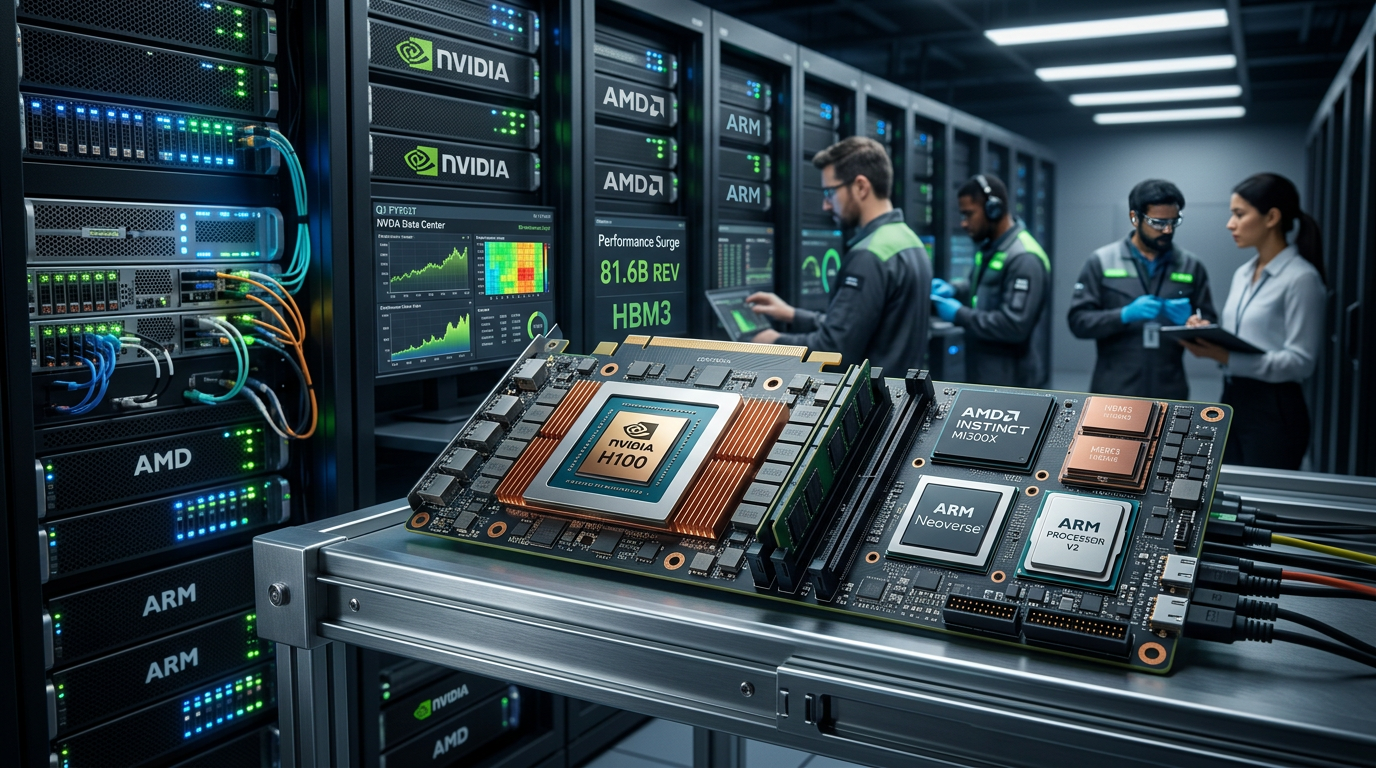
Five days ago, NVIDIA dropped numbers that should have broken the internet. They didn’t – which is itself the most telling part of this story.
On May 20, NVIDIA reported Q1 FY2027 revenue of $81.62 billion, up 85% year-over-year, against a Wall Street consensus of $78.86 billion. Adjusted EPS came in at $1.87, above the $1.76 estimate. Data center revenue – the real engine here – reached $75.2 billion, up 92% from the same quarter last year and now accounting for more than 90% of total company sales. Networking within that segment hit $14.8 billion, versus an estimate of $12.7 billion. The company guided Q2 revenue to approximately $91 billion, again above forecasts. And then the stock slid in after-hours.
That’s not a contradiction. That’s a market that has already priced in extraordinary, and is now asking: what comes after extraordinary?
The Broader Semiconductor Setup
This isn’t isolated to NVDA. ARM Holdings posted non-GAAP EPS of $0.60 for its fiscal Q4 2026, beating the $0.54 consensus by 11%. Full-year revenue hit a record $4.92 billion, up 22.79% year-over-year. Bernstein initiated with an Outperform and a $300 price target, citing growing demand tied to agentic AI CPU architecture. ARM has now more than doubled in calendar-year 2026, closing near $307 and printing fresh 52-week highs this week.
AMD isn’t far behind. Q1 2026 revenue came in at $10.3 billion, up 37.9% year-on-year. Data center sales of $5.8 billion rose 57% year-on-year. CEO Lisa Su guided Q2 to approximately $11.2 billion, clearing the $10.5 billion consensus. Bernstein upgraded to Outperform with a $525 target. Goldman moved to Buy at $450. AMD has effectively doubled year-to-date.
Options Market Behavior
Here’s where it gets interesting for options traders. NVDA call activity remains elevated, but implied volatility compressed sharply post-earnings – a textbook IV crush event. Traders who held long straddles or strangles into the print likely absorbed decay faster than the stock moved. That’s the trap of buying premium into a widely anticipated beat.
ARM options volume ran more than double average this week, with calls leading. The flow concentrated in near-term strikes above $300, suggesting positioning for continuation rather than mean-reversion. For traders expecting further momentum in ARM: a defined-risk bull call spread in the July or August expiration, positioned above current resistance near $310, would limit exposure to the premium paid while capturing the next leg if hyperscaler licensing demand accelerates into the next earnings cycle on July 29.
For AMD, the more cautious play – given the stock has already doubled and valuation questions are mounting – is a call spread rather than an outright long call. If you believe AMD sustains the data center growth narrative through Q2, a June or July bull call spread with the short strike near $490–$500 captures upside while defining the cost basis tightly.
The part people skip: INTC is up over 200% year-to-date. That’s not a typo. The reversal story there has been dramatic, and options flow has followed. Whether that momentum extends or reverts is the asymmetric question worth watching into June.
Risk note: All three names carry elevated valuations relative to historical norms. The AI supercycle thesis is intact, but single-name event risk – export controls, hyperscaler capex guidance cuts, or any disruption to Blackwell demand – could reprice quickly. Defined-risk structures are not optional in this tape. They’re the price of admission.