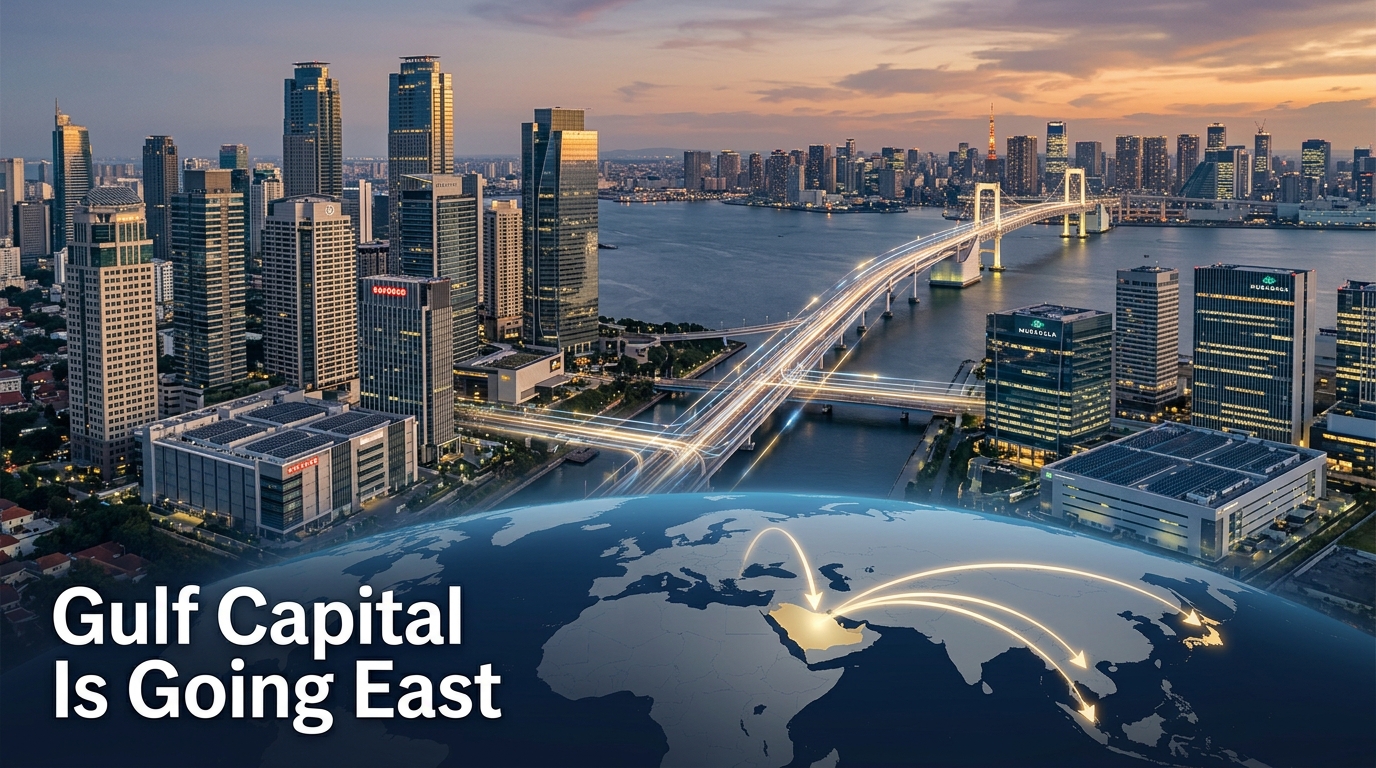
The biggest debate in global institutional investment right now is not which AI model wins. It is where the physical machines that run those models should live, and who should own them. Two deals announced within 72 hours of each other this week answered that question for a growing cohort of Gulf investors: Asia.
The Big Question
Gulf sovereign wealth funds and state-linked investors spent the first half of 2026 writing checks at a record pace. In the first half of 2026, Gulf funds invested $53.9 billion across 108 transactions, an all-time high, according to Global SWF data cited by Semafor. Most of that capital went west. Almost half went into the US, including funding rounds for Anthropic and xAI, showing that even as the Iran conflict raised questions about Gulf-US ties, it remains the main destination for recycled petrodollars. China was a distant second, receiving 17% of Gulf investments.
But something shifted in the last two weeks. Two transactions, each significant on their own, together signal a deliberate reorientation. The question institutions are now asking is whether Asia is becoming a structural allocation for Gulf AI capital, not just an opportunistic detour.
Why Wall Street Cares
Gulf investors are looking to Asia for opportunities in the AI race as conflict in the Middle East and Europe and supply-chain uncertainty raise the appeal of markets seen as relatively stable. That framing matters. It is not that Asia suddenly became more attractive on its own merits. It is that the perceived risk profile of the Gulf’s traditional AI destinations, including the US and parts of Europe, has quietly risen. The disruption tied to the Strait of Hormuz has carried an economic cost that has been measured in the tens of billions of dollars, including Reuters reporting about roughly $50 billion worth of oil lost over a 50-day period during the Iran war, forcing Gulf funds to accelerate their own diversification logic.
The talks with a Persian Gulf state underscore growing global interest in securing critical AI assets in countries viewed as relatively insulated from geopolitical tensions. Japan and Indonesia fit that description. Neither is inside a conflict zone. Both carry stable regulatory regimes and, crucially, each has something the Gulf’s AI ambitions cannot manufacture at home: abundant land with grid access.
The Bull Case
The Ooredoo deal is the cleaner of the two to read. Ooredoo Group announced its expansion into AI compute through a strategic investment in Zankore, a dedicated AI computing and neocloud platform in Indonesia, committing approximately $800 million as a founding shareholder and lead investor for a 49% stake. The commercial logic is straightforward. Ooredoo has said this initial investment is projected to generate around $600 million in cumulative EBITDA over the first five years, based on current estimates.
The demand signal backing that projection is real. Southeast Asia’s data-center capacity demand is widely expected to grow materially through 2030, with AI workloads a key driver of incremental capacity needs. Zankore will be developed in partnership with Indosat Ooredoo Hutchison, Nokia, and Nvidia, combining telecommunications expertise with AI computing capabilities, and the platform is targeting 1 GW of Nvidia DSX AI Factory capacity. That is not a modest pilot. It is a platform-scale bet on a geography that Ooredoo already knows well. Ooredoo has had a foothold in Indonesia since the early 2010s through its ownership in Indosat, and Indosat Ooredoo Hutchison was formed after the merger that closed in January 2022.
The Japan story is larger in dollar terms and carries a different strategic logic. Mubadala Investment is considering investing up to roughly $6.3 billion into building an AI data center in Japan’s Akita prefecture. Reports have said the facility could pack about 500 megawatts of capacity and is targeting an operational launch in the early 2030s. If built, the facility would be among Japan’s largest proposed data centers. Japan is actively courting this kind of capital. The government has released strategic plans to expand digital infrastructure and encourage more distributed data center development outside major urban centers, including policy work that highlights the need to support AI-oriented computing resources and the power system that backs them.
The Bear Case
The counterargument runs through returns, not geography. Concerns have intensified during reporting season as investment has consumed hyperscalers’ cash, and Asian chipmakers have been hit by fears of overcapacity. Despite strong revenue growth, concerns about capital expenditure and free cash flow have contributed to volatility in tech-heavy indices. If the AI infrastructure buildout overshoots demand in the near term, the assets that Gulf investors are buying in Asia do not get a free pass from that math simply because they are in Jakarta or Akita rather than Northern Virginia.
There is also a subtler risk. The question for Gulf investors, as one analyst put it, is not whether compute will be cheap, but whether the firms consuming it will be domestic. A 1 GW data center in Indonesia is only as valuable as the enterprise AI demand that fills it. That demand exists in aggregate across Southeast Asia, but it is not yet concentrated in the kind of hyperscaler anchor tenants that underwrite North American data center economics.
The Evidence
The pattern across Gulf AI infrastructure is becoming harder to dismiss as coincidence. Abu Dhabi artificial intelligence investor MGX closed its first dedicated AI fund with $49 billion in commitments, exceeding its $45 billion target, according to MGX and reporting carried by outlets including Reuters. That closing message matters because it signals the scale of capital now available for both software and physical compute. MGX has said Fund I has invested in 14 companies, spanning parts of the AI stack that include infrastructure and enabling platforms.
Some Gulf allocations into Asia have already been meaningful, but the specific dollar totals vary by data provider and time window, and they are easy to overstate when aggregating across different categories of sovereign and state-linked capital. The safer read is directional: Gulf funds have been building positions across multiple Asian markets for years, and the Indonesia and Japan transactions make the eastward push harder to wave away as incidental.
A fund required to show returns on a standard 10-year cycle struggles to justify committing capital to infrastructure that needs five to seven years just to reach the grid. Sovereign capital, operating on longer time horizons and with different constraints than a closed-end fund, can lock in power access, land, and construction years before the first compute job runs. That structural patience is the actual competitive advantage Gulf funds bring to Asia, and it is exactly what long-lead data center development requires.
The Mavens’ View
Experienced infrastructure investors read these two deals less as bets on specific AI applications and more as bets on electricity access. The Akita site matters because Japan has been actively courting foreign investment in data center infrastructure and has been encouraging more decentralized digital infrastructure outside the biggest metro areas, and Akita fits that profile. Renewable power with guaranteed grid access is the scarcest input in AI infrastructure. Owning it in a politically stable country with active government incentives is a different risk profile than leasing capacity in a contested region.
The Indonesian bet is about market position as much as returns. Ooredoo’s CEO made the strategic intent explicit: “We are taking the next logical step by adding AI compute to our portfolio, extending our approach into the high-growth Southeast Asian market, one of today’s most dynamic AI infrastructure opportunities. We believe AI will define the next decade of value creation in emerging markets.” That is not the language of a passive yield-seeking investor. It is the language of a fund trying to own the infrastructure layer of an emerging digital economy before the major cloud providers lock up the anchor positions.
What Investors Are Missing
Most analysis of Gulf AI investment focuses on the headline numbers and the US relationships. The less-discussed consequence is what this eastward capital flow does to the competitive dynamics of Asian AI infrastructure itself. Until recently, hyperscalers, primarily Amazon Web Services, Microsoft Azure, and Google Cloud, have dominated the economics of data center development across Asia by controlling both demand and supply. Gulf capital entering as an independent infrastructure owner changes that balance.
A Gulf-backed neocloud platform in Indonesia, targeting 1 GW at Nvidia specification, can offer compute access to local enterprises and AI developers that does not flow through a US hyperscaler. That is not merely a commercial alternative. In a geopolitical environment where Southeast Asian governments are carefully managing their relationships with both Washington and Beijing, a Gulf-backed, Nvidia-equipped compute platform occupies an interesting middle ground. It carries US-grade chip specifications without the political baggage of a US cloud provider. That positioning may prove more valuable than the yield projections currently suggest.
Stocks to Watch
- Nvidia (NVDA): Both Zankore and the Akita project are built on Nvidia infrastructure. Reports around the Zankore launch have said the platform is targeting 1 GW of Nvidia DSX AI Factory capacity and an initial buildout on the order of hundreds of megawatts over 2027. Gulf capital routing through Asia does not diminish Nvidia’s position. It extends the total addressable market for Nvidia’s data center segment into geographies that were previously underpenetrated.
- Nokia (NOK): Nokia appears as a supplier in the Zankore partnership announcement, a role that is easy to overlook at first read. As Gulf-backed compute platforms scale across Southeast Asia, Nokia’s networking layer becomes a recurring revenue line inside an infrastructure build that has a stated path to 1 GW. That is not the Nokia most Western investors are watching.
- Indosat Ooredoo Hutchison: The local Indonesian partner in Zankore, already deeply embedded in the country’s mobile and broadband infrastructure, gains a meaningful new revenue stream from the AI compute platform while contributing the local regulatory relationships and operational footprint that outside investors cannot replicate quickly.
- Mubadala Investment (via MGX): Not a listed equity, but its portfolio companies are. Bloomberg has reported that MGX plans to deploy capital at a pace that could run into the high single-digit billions per year. Investors in MGX-linked public vehicles or in the hyperscalers and chip companies that MGX backs should treat the Japan data center as a signal of further Asian deployment to come.
- Japan’s regional power and grid infrastructure: This project is expected to gain momentum, aligning with the Japanese government’s policy direction to decentralize data centers to regional areas. A 500 MW facility in Akita will require substantial local grid investment, creating downstream demand for Japanese utilities and grid operators that is not yet fully reflected in sector valuations.