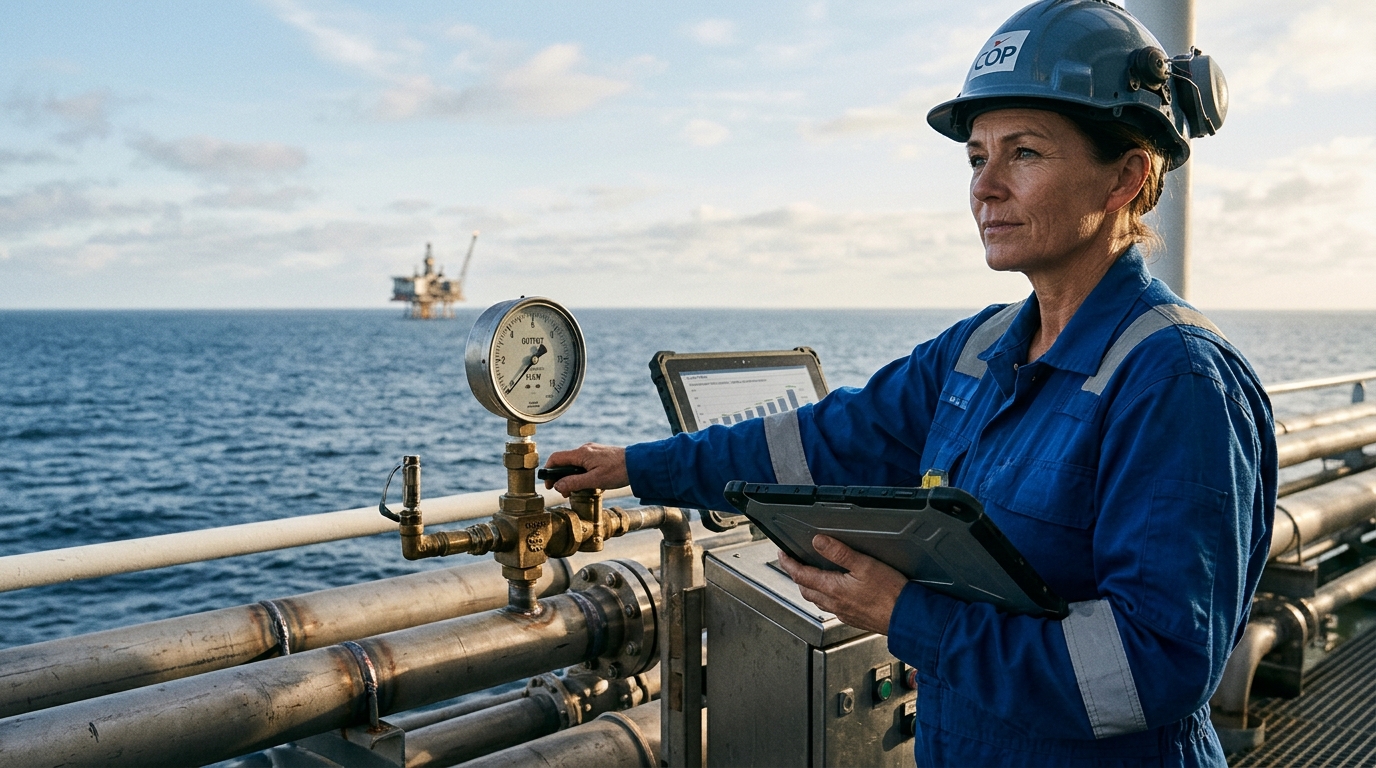
ConocoPhillips operated in Norway for more than five decades. On Monday morning it agreed to hand all of it over to Vår Energi for $4.425 billion, and the market’s first question was entirely the right one: where does the money go?
The answer, based on what COP has told investors, is mostly back to you.
ConocoPhillips plans to direct proceeds from the sale toward general corporate purposes and potentially additional share repurchases in 2027, supplementing its commitment to return approximately 45% of cash from operations to shareholders. That commitment is not new language. The company says its cash-from-operations return framework has averaged 45% over the last decade, and management has repeatedly said there is no reason to target lower levels going forward.
The definitive agreement covers ConocoPhillips’ Norway business and its 40.25% interest in and operatorship of the U.K. Teesside oil terminal. Total consideration is expected to be $3.9 billion, including the remaining 2026 tax liability of approximately $1.4 billion payable in the first half of 2027, and net cash proceeds of approximately $2.5 billion. The transaction is expected to close by the end of the first quarter 2027, subject to approval by the Norwegian Ministry of Energy and regulatory conditions.
The $2.5 billion in net cash lands at a company that is already running hard on buybacks. As of September 30, 2026, ConocoPhillips had repurchased $44.7 billion of common stock since its current program began in late 2016. Three weeks ago the board raised the quarterly dividend by 11%, pushing total third-quarter shareholder distributions to $3.4 billion, including $2.4 billion of share repurchases.
The exit fits a pattern the Norwegian Offshore Directorate has flagged in its 2026 resource report. Large international companies have pulled out, and development of new projects on the shelf is now largely dominated by Norwegian-based companies such as Equinor, Aker BP, and Vår Energi. For COP, Norway represented proved reserves of roughly 221 million barrels of oil equivalent at year-end 2025, meaningful, but not core to a capital allocation model built around the Permian Basin and returning cash.
Vår Energi sees those same barrels differently. The acquisition will increase Vår Energi’s long-term production target to above 500 thousand barrels of oil equivalent per day into the mid-2030s. The company expects the deal to deliver between $700 million and $1 billion of synergies and additional value creation on a net present value post-tax basis. Vår Energi says the transaction strengthens its position as Europe’s largest independent E&P company.
The lesson here reaches well beyond COP or Norway. When a major sells mature assets at a full price, the question is never really about the asset being sold. It is about what the capital does next. A company that channels proceeds into buybacks and dividends is shrinking its share count and growing per-share cash flow. One that reinvests in marginal new projects may be buying production growth at the expense of returns.
ConocoPhillips’ pre-dividend free cash flow breakeven sits in the mid-$40s WTI and is targeted to improve to the low $30s by 2029, which means the Norway sale proceeds arrive at a business that does not need them to survive any plausible oil price environment. That is precisely when returning cash to shareholders makes the most sense.
The enduring lesson: when evaluating any energy holding, the asset base matters less than what management does with the cash it generates. COP’s Norway exit is a reminder that the most important question in energy investing is not how much oil a company has in the ground. It is how reliably it converts that oil into wealth for the people who own the stock.