Six weeks ago, SpaceX was briefly worth more than Amazon and Microsoft. Today it is barely holding above its IPO price of $135. That’s a 40% round-trip in less than two months, and it tells you everything about the gap between a great company and a great stock at the wrong price.
Here’s where things stand right now.
The Numbers
- IPO date: June 12, 2026 at $135/share
- Post-debut peak: $225.64 intraday on June 16
- Current price (July 15 close): $135.27
- Decline from peak: roughly 40%
- Q1 2026 revenue: $4.694 billion, up about 15% year over year
- Starlink subscribers: ~10.3 million worldwide (as of March 31, 2026)
- Q1 net loss: $4.30 billion
- First public earnings: August 6, 2026
The IPO raised about $85.7 billion and, for one brief week, made Elon Musk the world’s first trillionaire. Then reality showed up.
What Analysts Are Saying
- JPMorgan: Overweight, $225 price target
- Morgan Stanley: $300 price target
- Raymond James: Strong Buy, 470%+ implied upside
- UBS: Buy, 54% upside from current levels
- BofA Securities: Buy, $235 target
Dozens of analysts now cover the stock, and the consensus is still bullish. And yet the stock keeps sliding.
Part of that makes sense. Passive inflows from the Nasdaq-100 inclusion on July 7 were supposed to be a tailwind. Instead, the stock sold off that day. Leveraged single-stock ETFs tied to SPCX have also been volatile since launch. The momentum crowd has moved on.
Tonight’s Test: Starship Flight 13
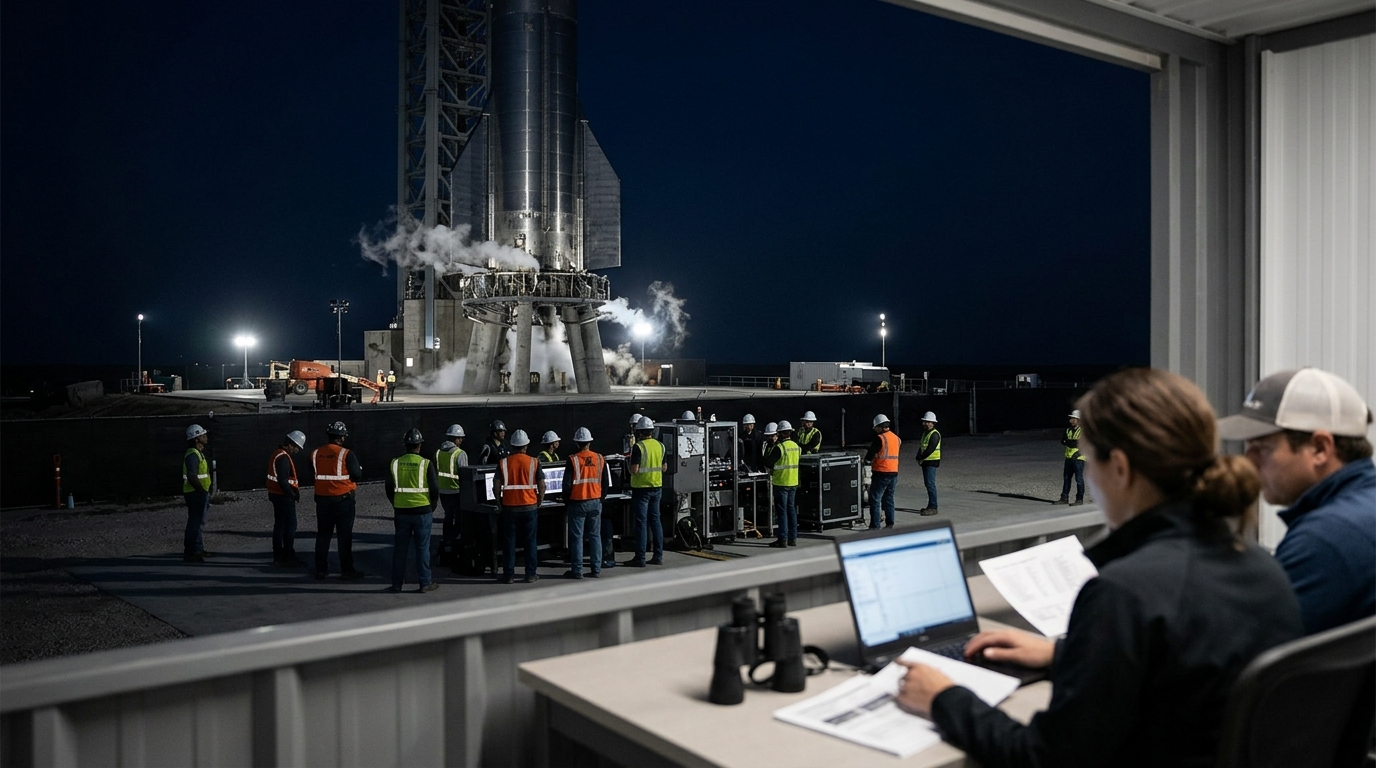
Scheduled for no earlier than 6:45 p.m. ET from Starbase, Texas, Flight 13 is not just another launch. For the first time, Starship will attempt to deploy 20 Starlink V3 satellites. These satellites are newer and larger than prior versions, and SpaceX is using Starship to test the deployment and in-space performance of this next-generation design — with the satellites expected to reenter on a suborbital trajectory rather than remain in orbit.
SpaceX reported a $4.9 billion net loss in 2025 and spent roughly $3 billion on Starship R&D. Flight 12 was impacted by a Raptor engine issue that prevented an in-space relight attempt. Flight 13 is supposed to fix all of that. SpaceX says software and operational updates address the prior issues. Investors want proof, not promises.
The deeper math is what matters. Falcon 9 currently launches cargo at about $2,700 per kilogram in widely cited estimates. If Starship works at scale, that cost could drop dramatically. That cost reduction is the foundation of every bull case: next-gen Starlink, lunar logistics, eventually Mars. None of it pencils out economically at Falcon 9 prices. All of it becomes viable if Starship delivers.
But here’s the catch. Achieving that requires lots of launches per vehicle with minimal refurbishment between flights. That has never been done. Wall Street is pricing a version of SpaceX that does not yet exist.
Bull / Base / Bear
Bull: Flight 13 successfully deploys its Starlink payload. Sentiment recovers ahead of August earnings, which could show accelerating Starlink growth. Analysts revise targets higher. Stock reclaims $175 before year-end.
Base: Flight 13 is partially successful but not the clean break investors need. Stock grinds sideways between $130 and $155 until August 6 earnings. The first public financial report becomes the real catalyst, positive or negative.
Bear: Another Starship failure shakes confidence in the core investment thesis. Combined with the stock’s high price-to-sales multiple and ongoing losses, shares retest the $120s. The next share unlock event accelerates selling pressure.
What to Watch
Three things matter tonight: stable booster separation, successful engine relight, and actual Starlink satellite deployment. All three need to work. One failure probably doesn’t sink the stock permanently. Two or three failures in the same flight and this becomes a much harder hold heading into August earnings.
The August 6 earnings report is actually the bigger event. Investors will want to see evidence that the AI and infrastructure buildout is adding real revenue rather than just burning cash. Estimates for full-year 2026 revenue vary widely by source and are moving quickly this early in the company’s public life, so treat any single number with caution.
For informational purposes only.