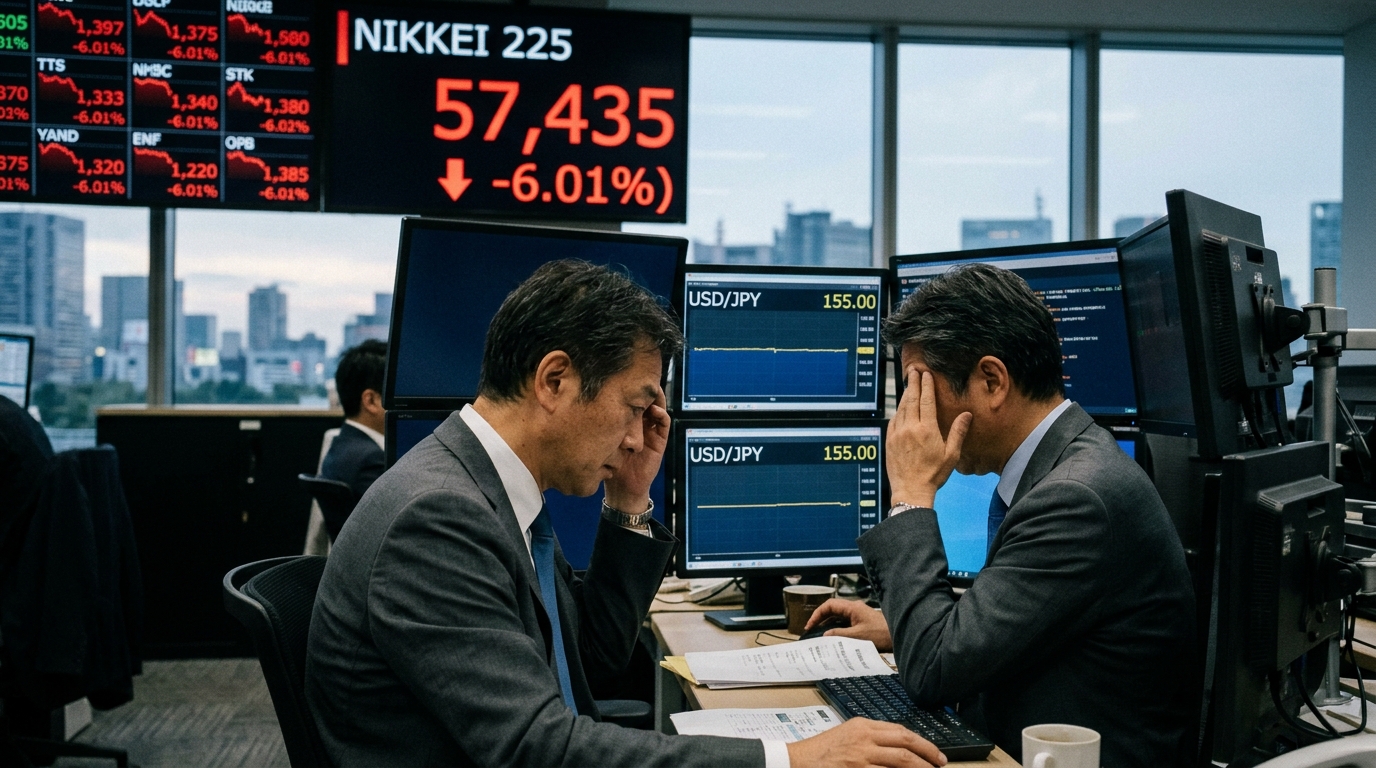
The conventional script for Japanese risk-off is well established: stocks fall, the yen rallies, carry trades unwind, and the currency’s strength becomes its own news cycle. Friday produced the stock crash on cue. The yen did not read the script.
The Nikkei 225 dropped about 6% to roughly 57,435, putting the index more than 20% below its historic high of 72,831.73 reached on June 22, satisfying the textbook definition of a bear market. The broader Topix fell more than 6% in early trading. Breadth does not get much worse than that.
And yet the dollar rose to only about 158.26 yen during the rout, a move of well under one percent while equities were losing a fifth of their value from the summer peak. The yen caught a small safe-haven bid, then gave it back almost immediately.
That behavior is the signal. In August 2024, a far smaller equity selloff triggered a violent yen surge that cascaded into a global carry-trade unwind. Today’s move was comparatively muted, which suggests the yen carry trade is either already substantially unwound from prior episodes, or that dollar demand from the broader global risk-off is absorbing whatever safe-haven yen buying emerges. Faster BOJ tightening tends to narrow the Japan-U.S. interest-rate gap, which can reduce the appeal of borrowing in yen to fund higher-yielding bets elsewhere, a dynamic that can accelerate yen moves when markets get jumpy. The yen’s relative calm today argues there is less of that trade left to unwind than the size of the equity move would imply.
What Drove the Crash
The selloff in Tokyo followed a post-election drop on Wall Street, where falls in chipmakers snowballed as investors bailed from technology shares on speculation that Democrats will clamp down on the AI industry. A sharp selloff in technology and AI shares wiped an estimated $2.5 trillion from U.S. market value, and the damage spread east. The Nikkei’s slide was led by chip-related stocks, including a roughly 12% plunge in chip-testing equipment maker Advantest. SoftBank fell about 11%.
The BOJ Hike Still Coming
Onto a crashing equity market, Reuters this morning dropped a pointed piece of guidance. The Bank of Japan’s former chief economist Seisaku Kameda said Friday that the BOJ is expected to raise interest rates in December and keep lifting borrowing costs until they reach 2%. The global market rout is unlikely to derail a hike next month unless volatility persists into the run-up to the December 17-18 meeting.
The BOJ is likely to raise its policy rate to 1.5% in December and keep hiking at a pace of roughly once a quarter until it reaches a terminal rate of 2%.
Kameda’s one stated risk to that path is telling: “The BOJ might pause if we see a full-fledged collapse in the AI boom that hits Japan’s economy through a severe downturn in US growth.” That condition is precisely what today’s selloff is testing.
What to Watch
Three things will clarify whether today’s yen calm is a sign of reduced carry exposure or simply a lag before a larger move. First, USD/JPY behavior into the December 17-18 BOJ meeting: a 1.5% BOJ rate in December would refocus attention on USD/JPY and short-term JGB yields. Second, U.S. jobs data this afternoon, where weak employment and slower wage growth could lower U.S. yields and weigh on the dollar, and if the equity selloff accelerates, yen buying could add to the pressure. Third, whether the AI selloff deepens to the point where it genuinely threatens U.S. growth, the one scenario Kameda identified as sufficient to give the BOJ pause.
A yen that refuses to rally during a 6% stock crash is not an absence of signal. It is a signal. What it means over the next six weeks depends on which of those three threads pulls first.