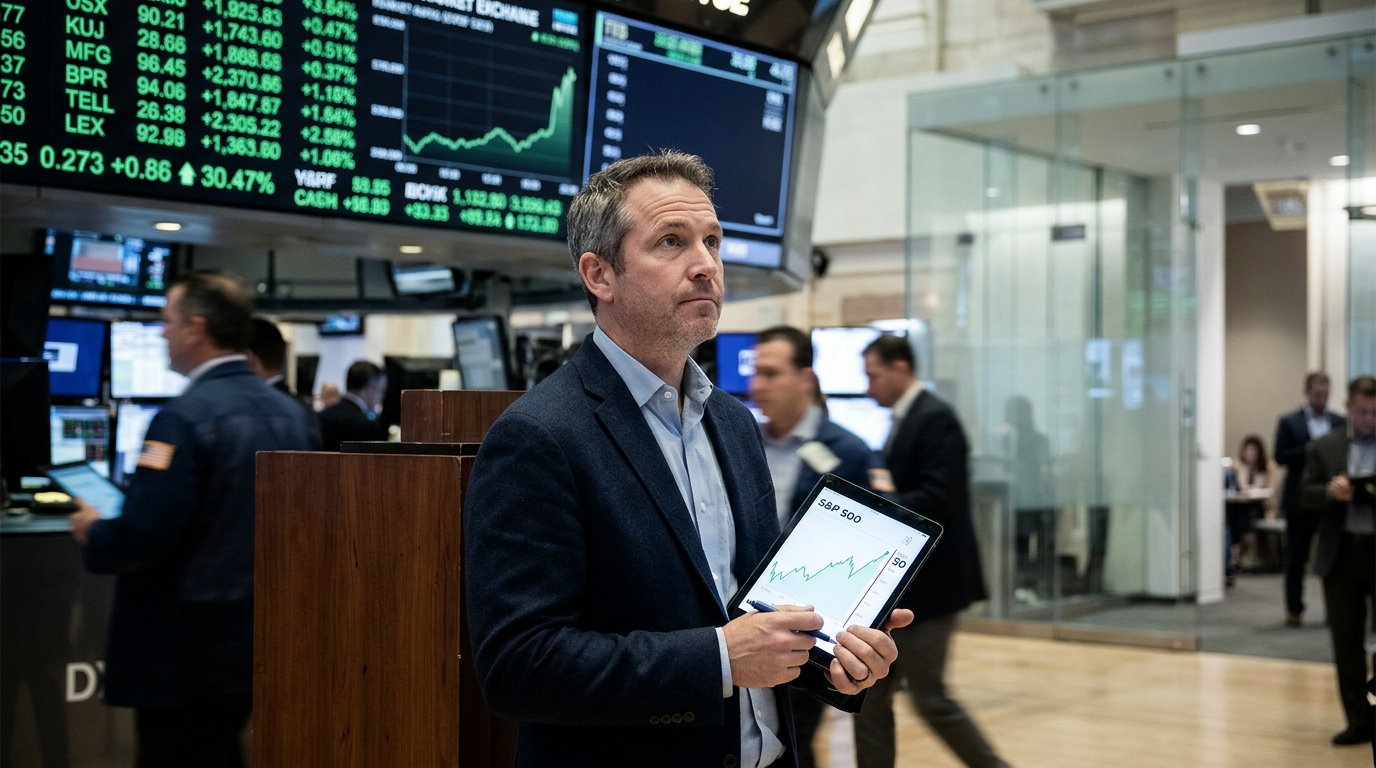
The S&P 500 closed Friday at 7,297.49, up 1.60% in a half-session that ended at 1:00 p.m. ET, capping what multiple outlets reported as the index’s best week since April 2025. Five point six percent in five days sounds like a turn. The harder question is whether it is.
Start with what actually drove the move. The leaders were the most damaged names in the AI hardware complex. SanDisk closed at $85.36, up 15.96%, while Coherent gained 14.07% to $223.79, Lumentum added 7.98%, and Seagate rose 7.90% to $509.66. SanDisk completed an 8-for-1 forward stock split effective after market close on November 19 and is still down roughly 18% since late October. A 16% session in a name that has been hit that hard is mean reversion, not a new trend, until proven otherwise.
The week’s catalyst was Nvidia’s board reinstating Jensen Huang as CEO on Monday, November 23. The S&P 500 closed that day at 7,237.17, up 326.78 points or 4.7%, after the board of Nvidia reinstated Jensen Huang as CEO. Most of the week’s points were made in that single session.
The Context That Matters
The S&P 500 is still down about 3.7% for November, with the Nasdaq down about 5.1% and the Dow down about 1.9%. November ends on Monday, and the S&P 500 goes into the final session on course for its worst November since 2008. That framing matters because month-end portfolio rebalancing on Monday adds an artificial demand bid. Pension funds and risk-parity accounts rebalancing into equities after a bruising month can extend a rally for a session without confirming that institutional conviction has shifted.
The sharp gains came as a combination of oversold conditions, with the S&P 500 sliding 8.6% the prior week, alongside Jensen Huang’s return. But given how quickly the index pulled back from its all-time high set October 6, there may be more pain ahead.
What Monday Needs to Show
Three things would upgrade this rally from holiday-volume bounce to something tradeable with conviction.
Breadth beyond the AI wreckage. Friday’s advance saw gainers outnumber losers by more than four to one, though the equal-weighted index lagged the headline index, which shows leadership is still concentrated. A Monday where the equal-weight S&P 500 matches or beats the headline index is a meaningfully different signal.
The 10-year Treasury yield staying contained. The S&P 500 can keep building on this week’s gains while the 10-year stays below 4.90%. A move back above 4.95% would bring back the pressure that drove last week’s decline. Friday’s 10-year yield ended around 4.94%, which puts it right at the edge of that range heading into Monday’s open.
VIX continuation below 23. The VIX fell 15.84% to 23.81 on Friday, its lowest close of the week. A further decline through 22 on a full trading session would signal that hedging demand is genuinely unwinding, not just compressed by thin holiday volume.
The Catalyst Queue
Monday is not packed with top-tier scheduled data releases, which removes one excuse for volatility but also strips away a potential positive catalyst. Marvell Technology reports Tuesday, December 1. Micron’s next earnings are expected on December 17, and memory guidance should influence NAND-linked names including SanDisk.
The week’s rally deserves respect for its breadth. All 11 S&P 500 sectors rose on Friday, and that rarely happens on a fade. But a 5.6% gain built on oversold mean reversion in thin Thanksgiving volume, led by stocks that remain well below their October levels, requires confirmation from a full session with real institutional participation before traders treat it as a durable directional call.
Watch 7,037 on the downside. Watch the equal-weight index and the 10-year on the upside. Monday’s close settles the argument.