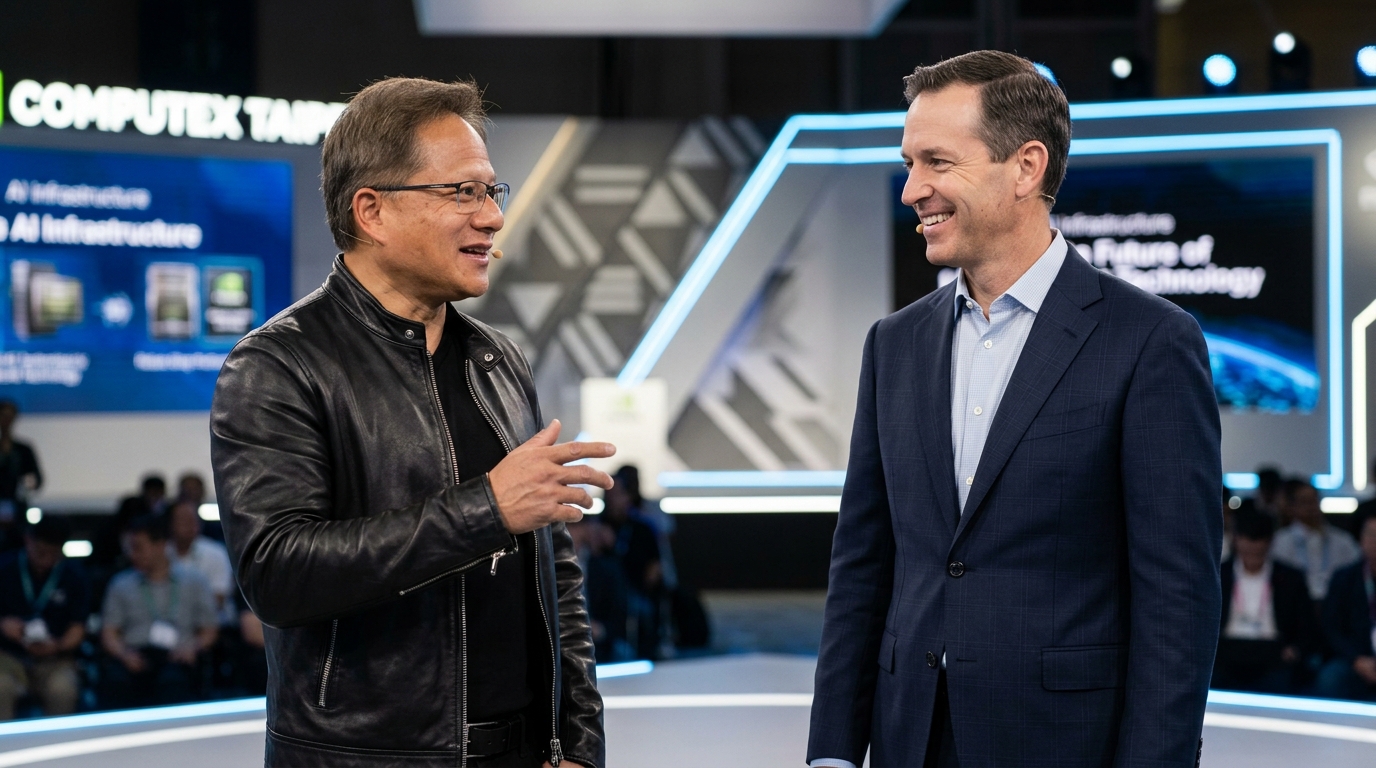
Four words from Jensen Huang. That’s all it took.
At Computex 2026 in Taipei on June 2, Nvidia’s CEO turned to Marvell Technology CEO Matt Murphy onstage and said, “The next trillion-dollar company, ladies and gentlemen.” The market didn’t hesitate. Marvell shares surged roughly 33% in a single trading session — the largest one-day gain in the company’s history — adding approximately $56 billion to its market cap in hours.
Here’s the thing, though. This wasn’t a random compliment. It was a thesis.
Most of the AI hardware conversation has centered on GPUs — who makes them, who’s buying them, who’s running out. But as AI data centers scale into colossal clusters of thousands of chips, a different problem quietly becomes critical: how do all those chips talk to each other? That’s Marvell’s lane. Huang noted that Marvell’s networking and connectivity chips are what make it possible to disaggregate massive computing workloads across entire data centers and still operate them as one unified system. Without that connective tissue, Nvidia’s own GPU clusters become far less effective.
The numbers behind the story are compelling. Marvell reported earnings per share of $2.84 in fiscal 2026 (ended January 31, 2026). On its Q1 fiscal 2027 earnings call on May 27, management guided that revenues from its interconnect products are expected to rise 70% — up from prior guidance of 50%. The company also flagged $16.5 billion in fiscal 2028 sales guidance. That kind of forward visibility is rare in semiconductors.
And then there’s the Anthropic angle — which most investors are sleeping on.
Anthropic filed a confidential S-1 with the SEC on June 1, 2026, following a $65 billion Series H that valued it near $1 trillion. The company has already committed to spending more than $100 billion with Amazon Web Services over the next decade, securing up to 5 gigawatts of compute capacity — with another 5 gigawatts locked in through Google agreements. That’s 10 gigawatts of contracted AI compute demand from a single company, before it’s even public. Marvell is one of the primary architects of custom silicon for hyperscalers, with 18 confirmed XPU sockets in its pipeline. When Amazon scales its Trainium chips to honor Anthropic commitments, Marvell’s design wins convert directly to revenue.
There’s a longer-term structural argument here too. Marvell also confirmed inclusion in the S&P 500, effective June 22, which introduces a whole new class of passive buyers who have to own it regardless of thesis.
The Risk Side
Marvell’s current market cap sits near $230 billion. The gap between that and $1 trillion is not small — and Huang’s declaration, however sincere, was made on a conference stage, not in a prospectus. The stock has already run aggressively, and the post-Computex pullback reminds investors that valuation still matters. Custom silicon revenue is concentrated among a handful of hyperscalers, which creates customer concentration risk if any one of them shifts strategy.
Marvell also competes in optical networking against high-growth names like Lumentum and Coherent. Being good at many things in a boom cycle is fine. Being average at a few things when the cycle cools is a different story.
Still — what’s interesting here is that Marvell may be one of the few AI infrastructure names with a credible path to tripling its current business rather than simply being priced as if it already has. That’s a different setup than a lot of what’s trading at AI-adjacent multiples right now. Worth watching closely as earnings and Anthropic’s IPO timeline both sharpen into focus this summer.