SanDisk closed Friday up roughly 8%, rising alongside a jobs report that briefly put a September Fed rate hike above 50% odds. Long-duration semis are supposed to sell off on that kind of news. They did not. That divergence matters more than the single-day move.
Why This Stock Now
SanDisk has delivered an extraordinary run in 2026, climbing roughly 550% and emerging as the S&P 500’s strongest-performing stock so far this year. Friday offered a fresh stress test: the U.S. economy added 162,000 jobs in August, nearly triple expectations, while unemployment held at 4.1%. A 25-basis-point September hike stood at about 41% on Polymarket before the release, then climbed above 50% afterward. Micron rose 5% and SanDisk 8% in early trading, sharply outperforming the broader market after the S&P 500 slipped about 0.2%. A stock holding up that well against a hawkish macro read is telling you something about how institutions are positioned.
The Business
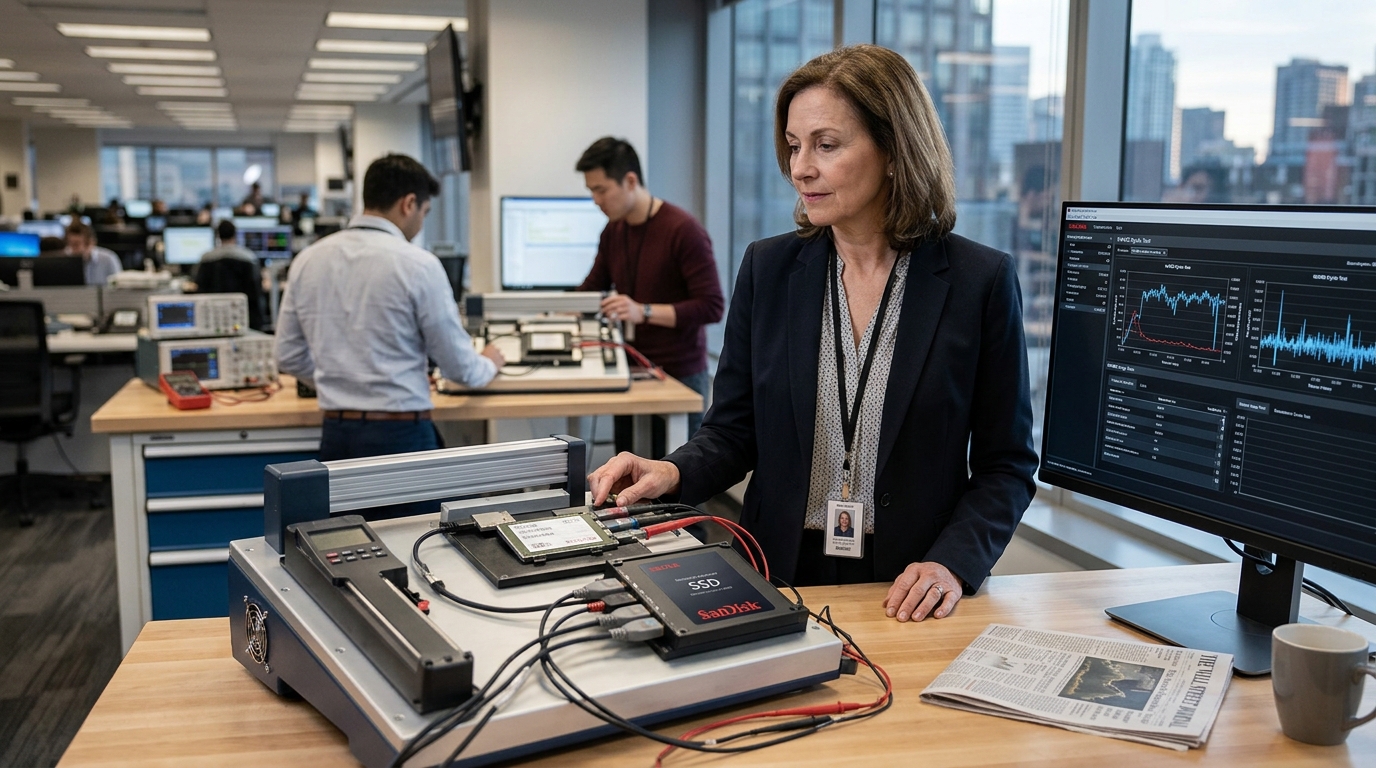
SanDisk’s explosive rally isn’t coming out of nowhere but is instead the result of a scarcity in the memory chip market, specifically for NAND flash. Being a major NAND producer, SanDisk is directly benefiting from this scarcity as AI infrastructure requires enormous amounts of high-performance flash storage, pushing NAND prices higher. SanDisk has also highlighted a 256TB NVMe enterprise SSD as part of its UltraQLC platform, a milestone capacity aimed at hyperscale and AI-heavy storage needs.
The company reported $6.9 billion in net income, or $43.97 per share, compared with a loss of $23 million a year earlier. Adjusted earnings reached $39.25 per share, while revenue surged to $8.97 billion from $1.9 billion.
Why Wall Street Is Paying Attention
To mitigate cyclicality, the company has been leaning hard into long-term customer agreements and authorized a $15.5 billion share buyback program. Customers are now opting for multi-year agreements with SanDisk instead of quarterly price negotiations, which could help reduce the cyclicality of its stock. Analyst opinions are split but carry weight in both directions: JPMorgan reinstated coverage with an Overweight rating and a $2,250 price target, while Wells Fargo lowered its target to $1,400 from $1,620, citing valuation concerns.
The Micron Test and What Could Go Wrong
The next inflection point is 25 days away. Micron Technology announced it will hold its fiscal fourth-quarter earnings conference call on Wednesday, September 30, 2026. The company is guiding for approximately $50 billion in quarterly revenue and non-GAAP earnings per share of about $31, numbers that would represent yet another step-change in a fiscal year already defined by explosive growth. If Micron confirms the NAND cycle is still accelerating, SanDisk gets another leg. If guidance disappoints, the whole sector resets lower fast.
The competitive risk is real and already showing up. CXMT and YMTC are both trying to expand, and the current supply environment is favorable for SanDisk, but strong profitability can encourage competitors to expand production aggressively, creating the possibility of today’s shortage becoming tomorrow’s oversupply. NAND flash contract prices are projected to increase only 10% to 15% quarter-over-quarter in Q3 2026, a marked slowdown from roughly 60% jumps recorded in the second quarter, with the cooldown driven by manufacturers’ unwillingness to absorb higher memory costs rather than by improved supply.
The Bottom Line
SanDisk is not a straightforward buy at these levels. SNDK’s forward PEG is extremely low versus typical sector norms. While this looks like a screaming buy on paper, it reflects deep market skepticism about the sustainability of this level of hyper-growth beyond the current chip shortage. Friday’s behavior, though, changes the risk calculus slightly. A stock that shrugs off a hawkish payroll surprise while the broader index retreats is being bought by people who are not easily scared out. August CPI on September 11 and the Fed’s September 16 decision are the next tests, with another hot inflation reading potentially showing whether memory stocks can keep shrugging off rates. If you are inclined to own SNDK, the next three weeks are your window to size the position before Micron’s September 30 report forces the whole sector to reckon with whether the cycle still has teeth.