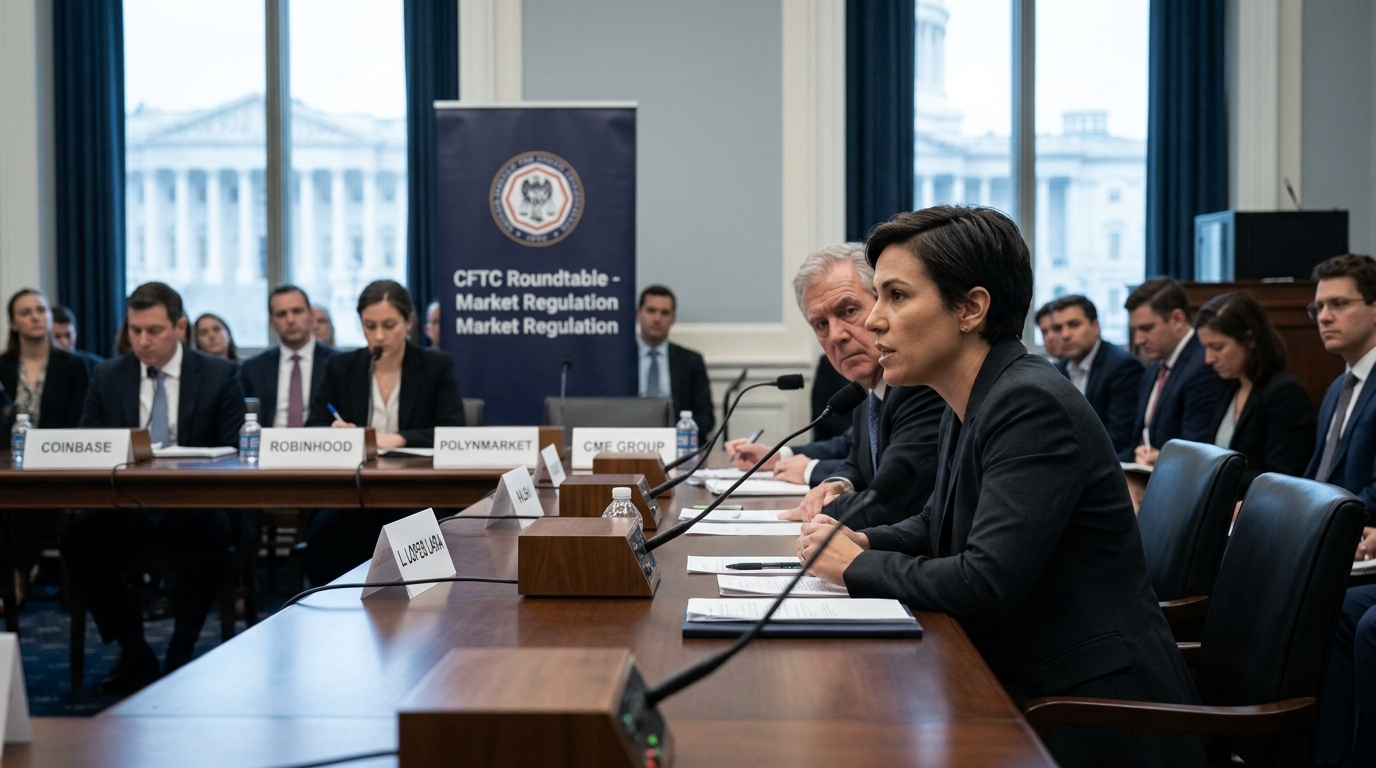
Washington had its spectacle Thursday. CME Group Chairman Terry Duffy and Kalshi co-founder Luana Lopes Lara clashed at a CFTC roundtable in Washington on August 20, in an exchange that featured personal insults and competing claims about market manipulation. FanDuel, DraftKings, Fanatics, Coinbase, Polymarket, and Robinhood all had seats in the room. The real question for equity investors isn’t who won the debate. It’s which publicly traded company has already turned event contracts into a durable revenue line, and whether the stock reflects it.
The answer is Robinhood, and the numbers make the argument better than any regulatory hearing can.
The Business
For the first time in Robinhood’s history, its prediction markets business generated more revenue in a single quarter than its cryptocurrency trading operation. In Q2 2026, the company made $156 million from event contracts and $100 million from crypto trading, according to its July 29 earnings release.
That crossover didn’t happen because crypto collapsed, though it did soften. It happened because Robinhood built dedicated infrastructure. The June launch of Rothera, a CFTC-licensed exchange and clearinghouse independently managed through Robinhood’s joint venture with Susquehanna International Group, was the structural decision behind the milestone.
Why Wall Street Is Paying Attention
The regulatory session that drew headlines this week is, for Robinhood, less a threat than a clarifying event. Duffy told the CFTC that about 2,500 event contracts have been self-certified since January 2025 without the agency opposing any, while arguing the Commission should do more to address manipulation risks as platforms grow. That framing validates the category. It does not imperil Robinhood, which routes event contracts through a CFTC-regulated structure.
Meanwhile, traditional finance is voting with capital. Intercontinental Exchange, the parent of the New York Stock Exchange, completed a new $600 million direct cash investment in Polymarket in March 2026 after a prior $1 billion investment announced in October 2025, as part of an arrangement that can total up to $2 billion. Polymarket has been reported to be exploring a new fundraising round at a valuation above $20 billion. ICE backing Polymarket at those levels is not a cautionary signal for the asset class; it is institutional confirmation.
Bernstein raised its Robinhood price target to $160 from $130, arguing the broker is best positioned to capitalize on a more than $70 billion opportunity across prediction markets, perpetual futures, tokenized equities, and compute-linked markets. Bernstein expects prediction markets to become Robinhood’s fastest-growing segment, forecasting revenue to reach $1.7 billion by 2028, a 64% compound annual growth rate.
What’s Driving the Opportunity
Event contracts revenue climbed more than 10x from a year earlier to $156 million in Q2, while the number of event contracts traded rose more than 10x to a record 13.6 billion. Robinhood generated record quarterly revenue of $1.31 billion, representing 32% annual growth.
The market is paying a P/E near 46, typical of a high-growth fintech. Goldman Sachs raised its HOOD target to $123 from $118 with a Buy rating earlier this month.
Shares closed Monday at $103.62, within a 52-week range of $63.52 to $153.86. The stock has given back ground from its October 2025 peak, which creates a reasonable entry relative to where some analysts see fair value.
What Could Go Wrong
The regulatory overhang is real, even if Thursday’s session was more theater than substance. Duffy noted that approximately 2,500 contracts have been self-certified since January 2025, none of which the CFTC opposed, a fact that could change under a more aggressive rulemaking posture. Any restriction on contract categories would reduce addressable volume.
There is also a seasonality problem. Robinhood used the 2026 FIFA World Cup as a marquee event tied to the launch and routing of contracts to Rothera. The question after the tournament is whether daily engagement sustains at anything near those levels.
Heavy insider selling warrants attention alongside the growth story, but the specific net figure in the draft could not be verified from primary, up-to-date filings.
The Bottom Line
The CFTC debate is framing event contracts as a regulatory battleground. For Robinhood, they are already a business. The Q2 2026 results show event contracts have already surpassed crypto transaction revenue in a single quarter. That trajectory, combined with Rothera’s infrastructure advantage and roughly 28 million funded customers, makes HOOD the clearest way to own the prediction market theme inside a regulated, publicly traded company. The valuation is not cheap. But the revenue line is real, growing rapidly, and last week’s CFTC session confirmed that Washington intends to keep this market alive, just with more rules around it.