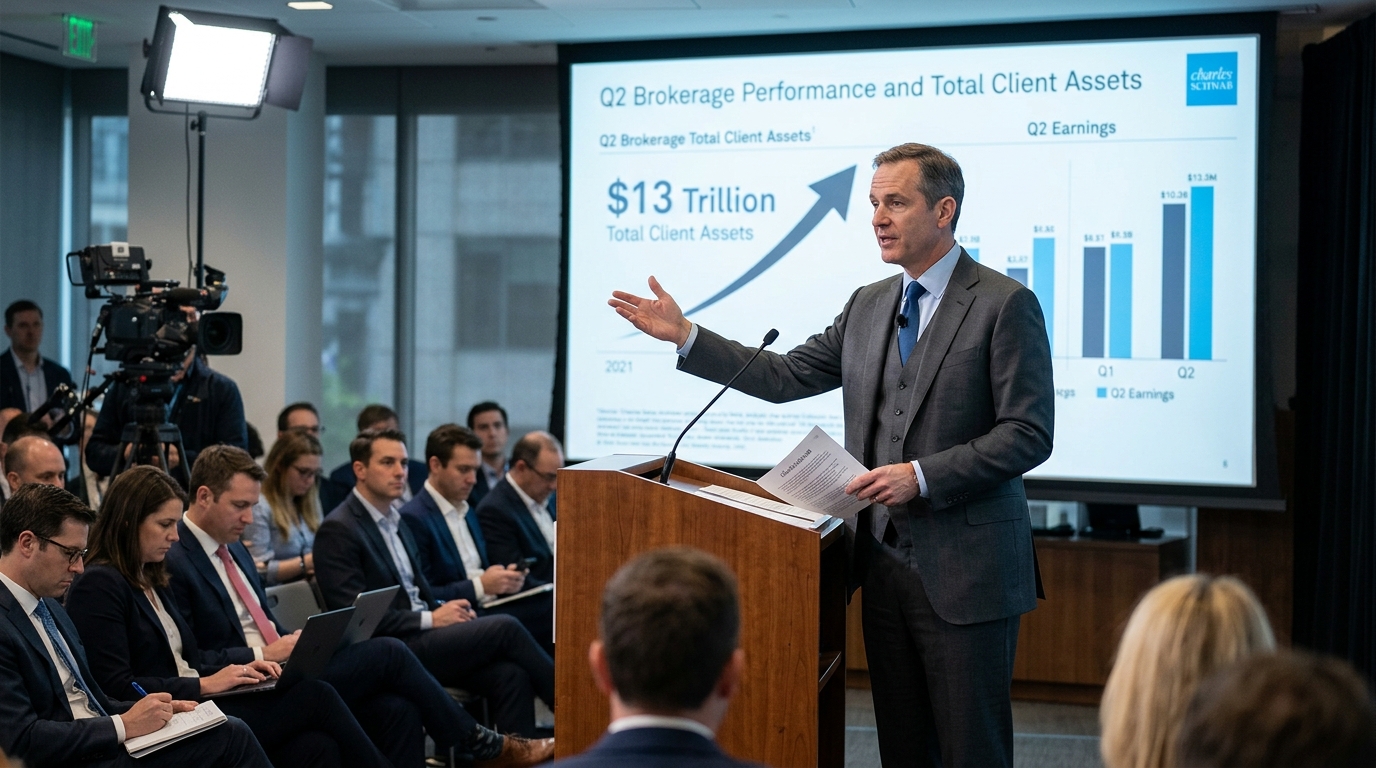
Here is the thing about Charles Schwab. The stock is up about 10% over the last month. The average analyst price target sits at $120.74. And today, before the opening bell, the company reports Q2 earnings against the most favorable brokerage backdrop in years.
That gap between where the stock trades and where analysts think it should be is the conversation worth having.
The consensus heading into this morning’s report was $1.53 in earnings per share. That would represent roughly 34% EPS growth versus the year-ago period. For a company this size, those are not small numbers.
What has been driving it? A few things at once.
Client assets. Schwab’s May operating update showed total client assets rose 27% year over year to a record $13.14 trillion. Core net new assets reached $49.9 billion in May alone, a record for the month of May. The firm added 461,000 new brokerage accounts in May. That kind of organic growth doesn’t happen by accident.
Trading revenue. Q2 was a volatile quarter. AI expectations shifted. Geopolitical tensions remained elevated. Middle East conflict kept commodity markets moving. All of that activity flows directly into Schwab’s trading engine. The Zacks consensus estimate for Q2 trading revenues was $1.14 billion, implying about 19.7% growth year over year.
Net interest income is the third pillar. Schwab’s first-quarter revenue came in at $6.48 billion, up 15.8% year on year, and Q1 EPS printed at $1.43 on an adjusted basis, up 38% year over year. The adjusted pretax margin hit 51.4%. That is operating leverage working exactly as it is supposed to.
Slight tangent, but it matters: Schwab has beaten consensus estimates repeatedly in recent quarters. Analysts know this.
The part people skip in a Schwab report is the deposit story. After the regional banking crisis of 2023, clients moved assets from bank sweep and other deposit balances into money-market funds. That trend has been stabilizing. Schwab is also moving into new territory, including direct spot cryptocurrency trading in bitcoin and ethereum via its Schwab Crypto rollout. Revenue diversification is real and happening now.
For context on peer performance, Goldman Sachs reported second-quarter 2026 net revenues of $20.34 billion, about 39% higher than a year ago. Morgan Stanley reported second-quarter 2026 net revenues of about $21.3 billion versus $16.8 billion a year ago (roughly 27% higher), topping Wall Street revenue estimates by about 8.7%. The brokerage and financial services segment has been on a run.
Schwab is not Goldman. It is a different business model, with different margin levers. But the macro environment that lifted Goldman and Morgan Stanley was the same one Schwab was navigating through April, May, and June. That matters for how this report reads.
What to watch on the call
- Net interest income growth rate
- Deposit stabilization and any commentary on bank sweep trends
- Whether management raises or holds its full-year revenue growth guidance
- New brokerage account growth in June, which would not be in the May operating update
The balance of risk here is interesting. The stock has already moved about 10% over the past month in anticipation of this report. That means a clean beat may get a muted reaction, while any guidance hesitation could give back some of those gains quickly.
But the longer-term picture has not changed. Client assets at $13.14 trillion create a durable fee and interest income engine. Schwab Wealth Advisory was highlighted as a key driver of managed investing momentum in Q1, and the business continues to compound.
At $102.50, the stock trades at a meaningful discount to the average price target. That gap either closes today or narrows over the next two quarters as the business proves out its trajectory. The report is the beginning of that answer.
This article is for informational purposes only and does not constitute investment advice. Investing involves risk, including possible loss of principal. Past performance is not indicative of future results. Always consult a qualified financial professional before making investment decisions.