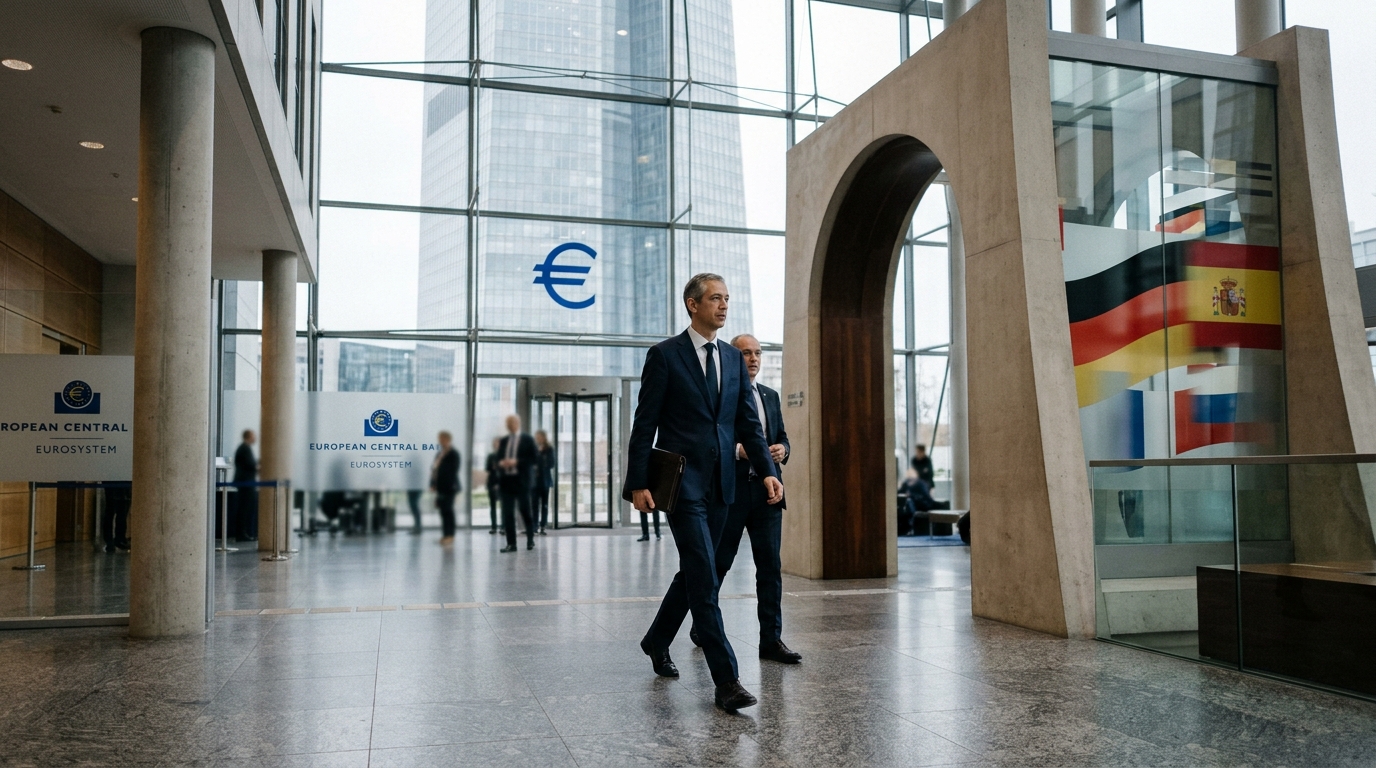
Add this to your watchlist, not your order ticket. Pablo Hernández de Cos moved a step closer to the European Central Bank presidency after a pivotal political deal in Berlin, where Germany will propose Princeton academic Markus Brunnermeier for the institution’s chief economist role.
By targeting the chief economist’s post, which shapes policy proposals, Germany made it easier for de Cos to win backing for the presidency, given the importance of maintaining balance between northern and southern Europeans on the ECB’s six-member Executive Board. The arrangement complicates the chances of Dutch candidate Klaas Knot, who had been considered a front-runner as recently as early November.
Germany’s cabinet, led by Chancellor Friedrich Merz, is set to ratify Brunnermeier’s nomination Wednesday.
Why the Deal Got Done Now
ECB President Christine Lagarde informed the Governing Council that she will step down on 7 February 2027, a move that accelerates a broader round of ECB Executive Board appointments.
EU governments are negotiating to fill three ECB Executive Board posts that will turn over in the coming months: the presidency (Lagarde stepping down on 7 February 2027), the market-operations role (Isabel Schnabel stepping down on 3 January 2027), and the chief economist role (Philip Lane’s term ends in May 2027). Three seats, three major economies, one deadline. The shape of the deal was always going to look like this.
What Traders Need to Know About de Cos
De Cos’ appointment would hand the top job to a southern European policymaker, reinforcing expectations that the central bank would use its firepower to contain any new sovereign debt crisis. That framing matters for peripheral bond spreads down the road.
His policy profile is harder to pin down than the headlines suggest. De Cos has built a reputation as an independently minded policymaker during his years at the Bank of Spain under Draghi and Lagarde. Money markets are pricing in further tightening into 2027, and economists expect de Cos would broadly continue the gradual path laid out under Lagarde. Some analysts have described him as slightly dovish at the margin, but more of a consensus-builder than an obvious policy driver.
Standard Chartered flagged that the implications for monetary policy are more nuanced than a simple hawk-dove distinction, with Brunnermeier’s influence as chief economist potentially mattering just as much.
The Euro Angle, Sized Correctly
This story is real, but its market impact is not today’s problem. Lagarde’s successor will be appointed by the European Council after the standard EU appointment process, meaning formal confirmation is weeks away at minimum. The presidency does not change hands until February 7. Rate policy under new leadership is a 2027 question.
What is worth monitoring now: how EUR/USD reacts if Germany’s cabinet formally ratifies the Brunnermeier nomination Wednesday. Any renewed speculation about ECB policy direction could move the pair on thin sessions. The bigger EUR setup takes shape as the confirmation process concludes and the board composition comes into focus. For now, file it, track it, and wait for the catalyst that actually moves the price.