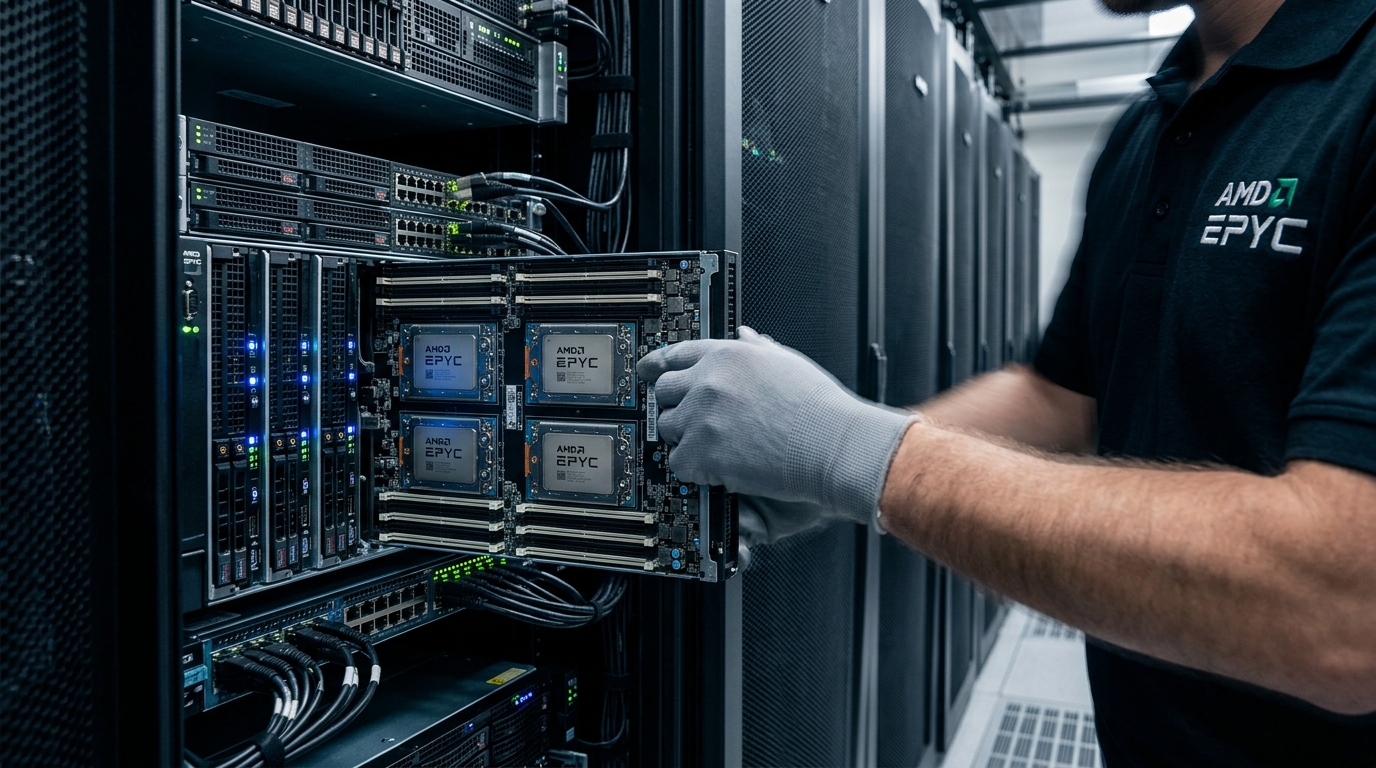
Everyone spent three years watching Nvidia. Fair enough — it was the trade of the decade. But something shifted in 2026, and if you’ve been paying attention to the semiconductor sector this year, you’ve noticed that AMD has quietly staged one of the most dramatic runs on Wall Street.
The stock is up more than 150% year-to-date. Its data center revenue crossed $5.8 billion in Q1. And the company is now, by some measures, selling out of its most important chips before it can manufacture them fast enough to meet demand.
This is a different story than the GPU boom. And it’s only getting started.
What’s Actually Driving This
The AI industry spent its first few years doing one thing: training massive language models. That workload is almost entirely GPU-dependent. Nvidia dominated. The rest of the chip industry watched.
But the industry has moved on. The focus now is running those models in the real world — inference — and increasingly, deploying AI agents that autonomously execute multi-step tasks, spawn sub-agents, retrieve data, and loop back on results. That’s Agentic AI. And it changes the chip economics entirely.
In agentic deployments, the CPU-to-GPU ratio can jump from roughly 8–12 CPU cores per GPU in training workloads to as many as 80–120 CPU cores per GPU. Every agent, and every sub-agent it spawns, requires dedicated CPU cores to orchestrate. The GPU still handles heavy computation. But the CPU is now the traffic controller, the memory manager, and the decision layer — and there’s no substituting it out.
That’s the structural shift. And AMD is sitting directly in the path of it.
AMD’s Numbers Speak for Themselves
- Q1 2026 Revenue: $10.3 billion — up 38% year-over-year
- Data Center Revenue: $5.8 billion — AMD’s primary growth driver, up 57% YoY
- Q2 Revenue Guidance: ~$11.2 billion — implying continued acceleration
- Server CPU Revenue Growth: AMD said it expects server CPU revenue to grow by more than 70% YoY in Q2
- Server CPU Market Share: 27.4% as of Q1 2026
- YTD Stock Performance: Up 150%+, market cap around $846 billion
CEO Lisa Su traveled to Taipei in late May and said AMD was asking manufacturing partners to ramp production given strong demand for AI. That’s not a scripted corporate update. That’s a CEO signaling a shortage.
The Market No One Fully Priced
Here’s where it gets genuinely interesting. AMD’s server CPU TAM estimate — the total addressable market they’re targeting — has been cited around $43 billion. AMD has said it now expects the server CPU market to reach roughly $120 billion by 2030. Bank of America’s estimate sits near $125 billion.
The GPU supercycle was loud and obvious. Nvidia’s revenue went from about $27 billion in FY2023 to $130.5 billion in FY2025. Impossible to miss. The CPU supercycle is quieter — but potentially more durable, because CPU demand from inference and agents is recurring and grows every quarter rather than front-loading like training buildouts do.
Slight tangent worth noting: Rackspace Technology stock climbed this week after announcing a major AI infrastructure partnership with AMD — a 30-megawatt deployment using AMD-based compute. That deal is a small but real example of AMD chips moving from hyperscaler wins to broader enterprise deployments. The customer base is widening.
Bull / Base / Bear
- Bull: Agentic AI deployments ramp ahead of schedule. AMD’s Venice CPU on TSMC 2nm ships on time, extending its technology lead. Server CPU revenue hits 70%+ growth through H2 2026. Meta, Microsoft, and Google all scale AMD GPU purchases alongside CPUs. Stock targets reach $665+.
- Base: Server CPU growth moderates to 40–50% YoY in H2. Data center revenue continues compounding. AMD holds and expands market share. Stock consolidates between $500–$550 before next catalyst.
- Bear: Macro slowdown delays hyperscaler capex. Intel’s Xeon 6+ gains traction with its 288-core advantage. Custom silicon from Google and Meta accelerates substitution. AMD pulls back 25–30% from current levels alongside a broader semiconductor correction.
The Risk You Shouldn’t Ignore
BTIG analyst Jonathan Krinsky has flagged that the Philadelphia Semiconductor Index has posted a very large year-to-date move in 2026 in a way that has drawn comparisons to prior late-cycle surges, and he has warned of the potential for a sizable pullback. AMD’s P/E ratio has stretched well above its five-year median. The fundamentals are real. But so is the risk of paying too much for even a great story.
AMD at roughly $846 billion in market cap is no longer a hidden gem. The question now is whether the CPU supercycle can grow into a valuation that was priced for perfection months ago.
What Matters From Here
Watch AMD’s Q2 earnings — expected in late July — for confirmation that server CPU revenue growth did, in fact, accelerate above 70% YoY as guided. If that number hits, the stock will reprice higher again. If it misses even modestly, expect a sharp reaction given how much optimism is already embedded. Also watch for any update on AMD’s EPYC Venice production ramp on TSMC’s 2nm node — that’s the next hardware generation, and its timeline will determine whether AMD can sustain its supply advantage heading into 2027.
The GPU boom changed everything. The CPU supercycle might be the trade that lasts longer.
For informational purposes only.