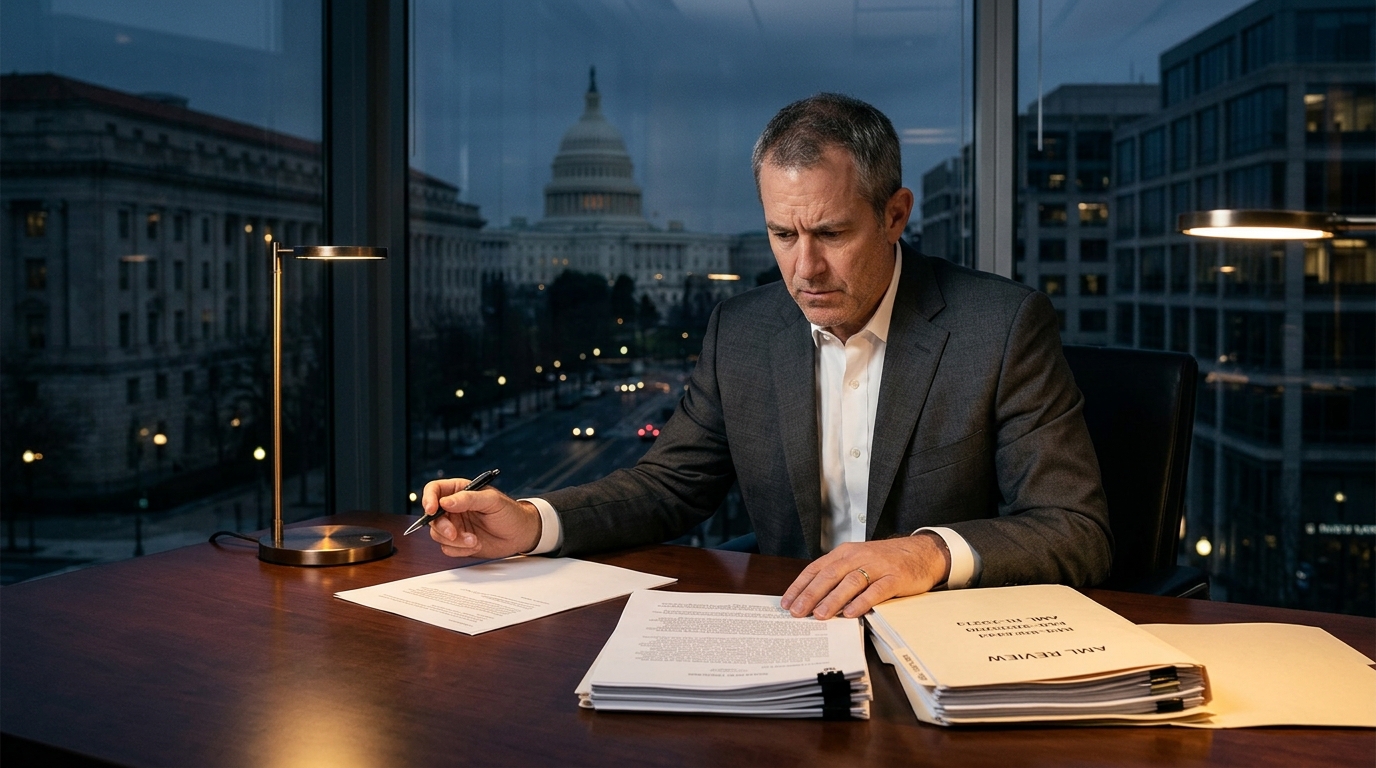
The signal did not come from the earnings deck. It came from a court filing dropped late Friday, August 1, 2026, after the options market closed.
The Signal
Capital One Financial said in a court filing that it closed accounts belonging to President Donald Trump’s real estate company in 2021 for legitimate reasons, after an internal review by the bank’s anti-money laundering team. That is a materially different defense than the one the company offered publicly when this dispute began. It is no longer a vague denial. It is an affirmative legal claim, one that points a specific internal compliance mechanism at a sitting president’s business.
The options market does not yet fully reflect what that shift means. Here is why it should.
Why It Matters
This case had already accumulated more political surface area than any bank litigation in recent memory. Capital One made the AML revelation in a filing asking a judge to toss out a Trump Organization lawsuit accusing it of illegally “debanking” the president’s company because of political discrimination following the assault on the Capitol on January 6, 2021. U.S. District Judge Roy Altman dismissed an earlier version of the suit on March 20, 2026, but allowed the Trump Organization to conduct discovery and gave it a deadline to file an amended complaint.
The AML disclosure does two things simultaneously. It gives Capital One the strongest substantive legal footing it has had in this case. It also raises the political temperature by several degrees. One legal expert described Capital One as being in “an impossible position”: it could settle for a relatively small amount with assurance of cleared transactions, benefiting shareholders short term, but “this type of ‘vigorish’ never ends, as business interests in authoritarian states have learned time and time again.”
The regulatory context adds another layer. A Capital One executive, Brian Johnson, was nominated by President Trump to lead the Consumer Financial Protection Bureau. Johnson pledged to recuse himself from any matters involving Capital One for two years if confirmed. But the recusal commitment does not resolve the underlying tension: Capital One is simultaneously defending itself against the president’s lawsuit and navigating a regulatory environment shaped in part by an official with deep ties to the firm.
During Johnson’s nomination hearing, Sen. Elizabeth Warren noted that the CFPB, under acting Director Russell Vought, dropped a lawsuit against Capital One after the company donated $1 million to Trump’s inaugural committee. The initial CFPB lawsuit alleged Capital One cheated consumers out of more than $2 billion in interest payments on their savings accounts. The AML court filing lands in the middle of all of that.
The Company Behind the Signal
Strip out the political noise and the underlying business has momentum that is easy to miss. Second-quarter net income was $3.0 billion, or $4.73 per diluted share. Adjusted EPS were $5.81 after acquisition-related items. Total net revenue rose 4% from the first quarter to about $15.9 billion.
CEO Richard Fairbank said Capital One is 14 months into its planned 24-month Discover integration and that the process is “going well.” Management said the company is still on track to deliver the full $2.5 billion in announced synergies, with technology and back-book conversions continuing through early next year.
The Discover card portfolio is experiencing a temporary loan growth slowdown as management integrates credit policies and trims high-balance revolver exposure to ensure long-term stability. Management expects the Discover loan-growth “brownout” to bottom around the fourth quarter of 2026. That is a known drag, not a structural break. Credit performance remains a significant tailwind, with delinquencies and charge-offs trending favorably and recent vintages performing better than those from 2022 and 2023.
The stock has not been rewarded for any of this. Shares have traded around $200 in late July. The gap between that analyst target range and the current price is already meaningful. The AML filing introduces a new variable that cuts both ways.
Market Expectations
What is the options market pricing right now? The implied volatility on COF has been elevated relative to the broader financial sector for most of 2026, reflecting the Discover integration overhang, two headline earnings misses earlier in the year, and the political litigation. The AML disclosure, dropped Friday after the close, is the kind of development that does not get priced into short-dated options until Monday morning. That gap is where the signal lives.
The relevant question is not whether Capital One will win the case. It almost certainly has strong legal grounds: AML reviews are routine compliance functions, and courts have historically given banks wide latitude in account closure decisions tied to them. The question the options market is really pricing is how much political retribution risk accompanies a bank that has now publicly invoked money laundering procedures against a sitting president’s company. That is a risk category that does not fit neatly into any standard credit or regulatory model.
Capital One’s heavy exposure to uncollateralized credit card and signature loans makes it uniquely vulnerable to consumer stress. Layer a politically charged legal fight on top of a $2.5 billion integration sprint, and the options market is likely underpricing near-term tail risk even as consensus analysts remain broadly bullish.
Strategic Considerations
For options participants, the focus that deserves attention here is a defined-risk long straddle or strangle positioned around the next meaningful catalyst: Monday’s market open reaction to the AML filing, and any court response in the coming weeks.
The logic is straightforward. Implied volatility on COF has not yet spiked to reflect the Friday filing. The stock is already under pressure from year-to-date underperformance. The AML disclosure creates two divergent paths. If the court accepts Capital One’s motion to dismiss, the legal overhang partially clears and the market may re-rate the Discover integration story more generously. If the Trump Organization files an amended complaint that survives, the political and regulatory exposure compounds.
Either outcome is a move. Neither direction is obvious enough to take a clean directional position. A strangle, buying an out-of-the-money call and an out-of-the-money put with the same expiration, captures movement in either direction. The key risk is time decay: if the court proceedings stall and the stock grinds sideways, theta erodes the position. Keep expiration at least 30 to 45 days out to allow for the court’s response timeline.
The alternative for those who believe the legal defense is strong and the Discover integration is undervalued: a cash-secured put at a strike well below current levels extracts premium while establishing a potential entry point if political headlines push the stock lower than the fundamentals justify. TD Cowen has a buy rating with a $253 target, while UBS holds a buy with a $275 target, suggesting the analyst community views current levels as an overshoot.
What to Watch
Three developments could confirm or challenge the thesis in the next several weeks. First, watch for the Trump Organization’s response to Capital One’s motion to dismiss. If the refiled complaint is again found deficient, implied volatility should compress and the stock could recover. If the complaint survives, headline risk stays elevated. Second, monitor how the CFPB leadership fight resolves in Washington: Johnson’s confirmation vote could directly affect whether Capital One faces renewed regulatory scrutiny or continued forbearance on the dropped savings-account enforcement. Third, watch credit quality data through the third quarter. Management expects the Discover loan-growth brownout to bottom around Q4 2026 and sees a catch-up in net interest margin in Q3 as average cash balances normalize. If those inflections arrive on schedule, they could overshadow the political noise entirely.
The AML filing is not a trade by itself. It is the options market’s next unanswered question, arriving on a Friday afternoon when nobody was positioned for it.