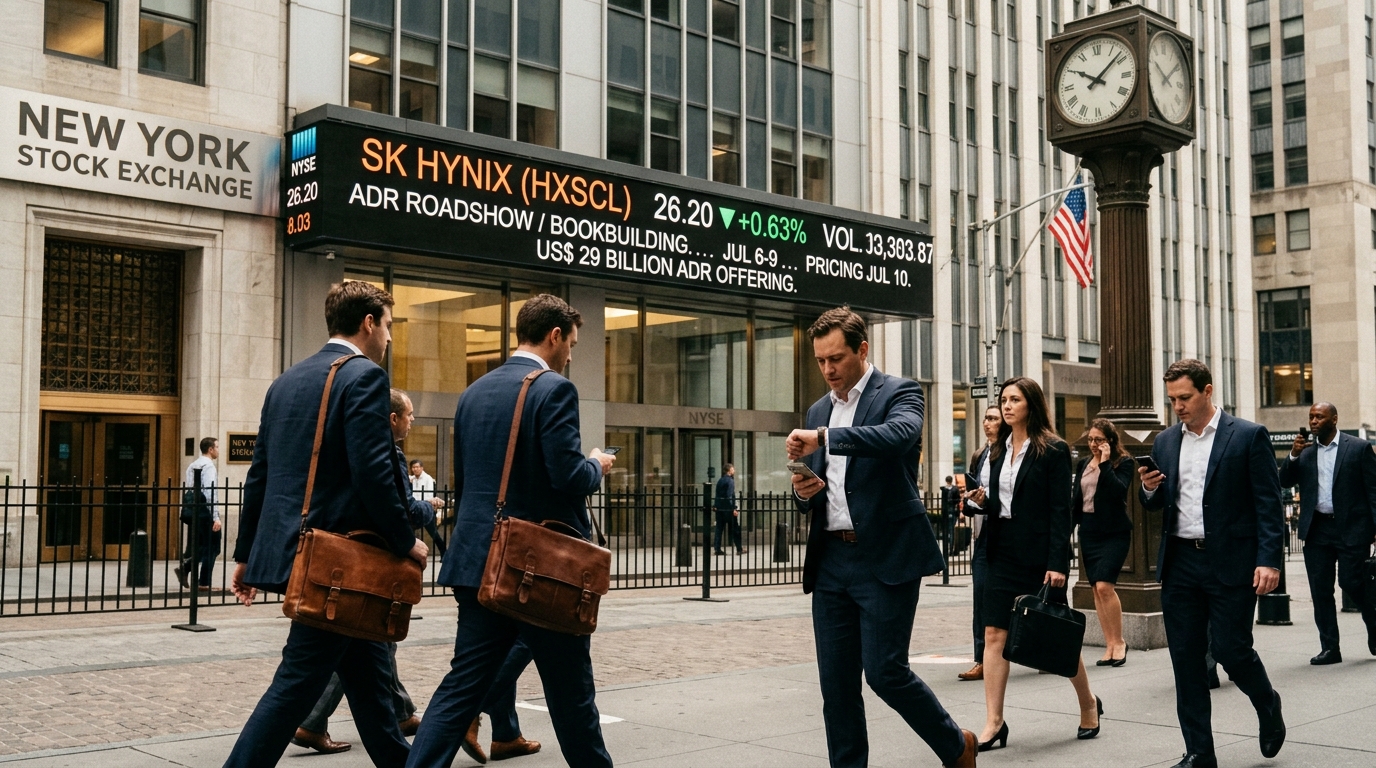
Today is not just a quiet Monday after a holiday weekend. SK Hynix is conducting its roadshow and bookbuilding process for overseas institutional investors from July 6 through July 9, with final offering price confirmation on July 10. That means the window is live right now.
The offering is targeting approximately $29 billion — which would make it the largest ADR listing in recorded market history, surpassing Alibaba’s $21.8 billion New York debut in 2014 and Saudi Aramco’s $25.6 billion IPO in 2019. It is not a close comparison. This is a different category of event.
What is SK Hynix? Most Western investors still couldn’t answer that question with confidence, which is part of the point.
As of Q1 2026, SK Hynix ranked first globally in HBM with a 56.4% revenue share, second in DRAM with a 29.1% market share, and second in NAND flash with an 18.5% share. Its customers include Nvidia, Google, and Microsoft. High bandwidth memory — the specialized chip that sits inside every major AI accelerator — is what SK Hynix makes better than anyone else on the planet.
The valuation gap is the whole trade here. SK Hynix currently trades at a forward price-to-earnings ratio of roughly 6.2x, compared to Micron’s 7x. HSBC analysts applied a 20% premium for the ADR listing, forecasting SK Hynix can start to catch up with Micron in valuation terms. Their rationale is straightforward: Micron has traded at an average 35% premium to SK Hynix over the past 13 years, driven by better access to U.S. investors and higher beta supported by a smaller earnings base. The ADR is the mechanism that closes that structural discount.
Think about what the TSMC comparison tells you. TSMC has traded on the NYSE for decades, and the years after American capital got easier access to it marked a sustained re-rating in how the market valued the business. SK Hynix is attempting the same move — but entering the U.S. market with AI HBM demand locked in, supply constraints forecast into 2027, and order books already sold out for 2026.
Proceeds from the offering are earmarked entirely for domestic production facilities: the Yongin Semiconductor Cluster’s first fab, a new advanced packaging plant in Cheongju, and the acquisition of EUV lithography equipment. This is not a balance-sheet raise. It is converting a record valuation into the physical capacity the next wave of AI demand will require.
There are real risks. The ADR listing does not change the underlying business’s cyclicality. A U.S. antitrust class-action lawsuit was filed on June 25, naming Samsung, SK Hynix, and Micron, alleging that DRAM price increases led to higher prices for IT products including MacBooks and iPads. That lawsuit is now listed in the company’s risk factors. It is not a dealbreaker, but it is a live overhang.
What’s worth watching beyond the listing itself is Micron. Analysts noted that Micron’s recent quarterly results — where revenue more than quadrupled — reinforced expectations that the AI memory market remains supply-constrained, a positive signal for SK Hynix exposed to the exact same dynamics. When SK Hynix lists Thursday as SKHY, it will be trading alongside its closest competitor on the same exchange for the first time. That creates a real-time valuation reference that didn’t exist before.
Future inclusion in the Nasdaq-100 could trigger passive fund inflows from ETFs like QQQ. That part is not priced yet. The roadshow ends in four days.