The GPU cluster gets the headline. The pipe that keeps it from melting gets none. That asymmetry is where the trade is.
Rack densities in AI data centers have moved past the point where thermal management is a secondary design question. High-density installations today routinely run around 85 kW per cabinet, more than triple what conventional designs were built to handle. Next-generation workloads project 200-250 kW per rack. Air cooling collapses past roughly 50 kW. The entire buildout depends on liquid.
The Coupling Bottleneck
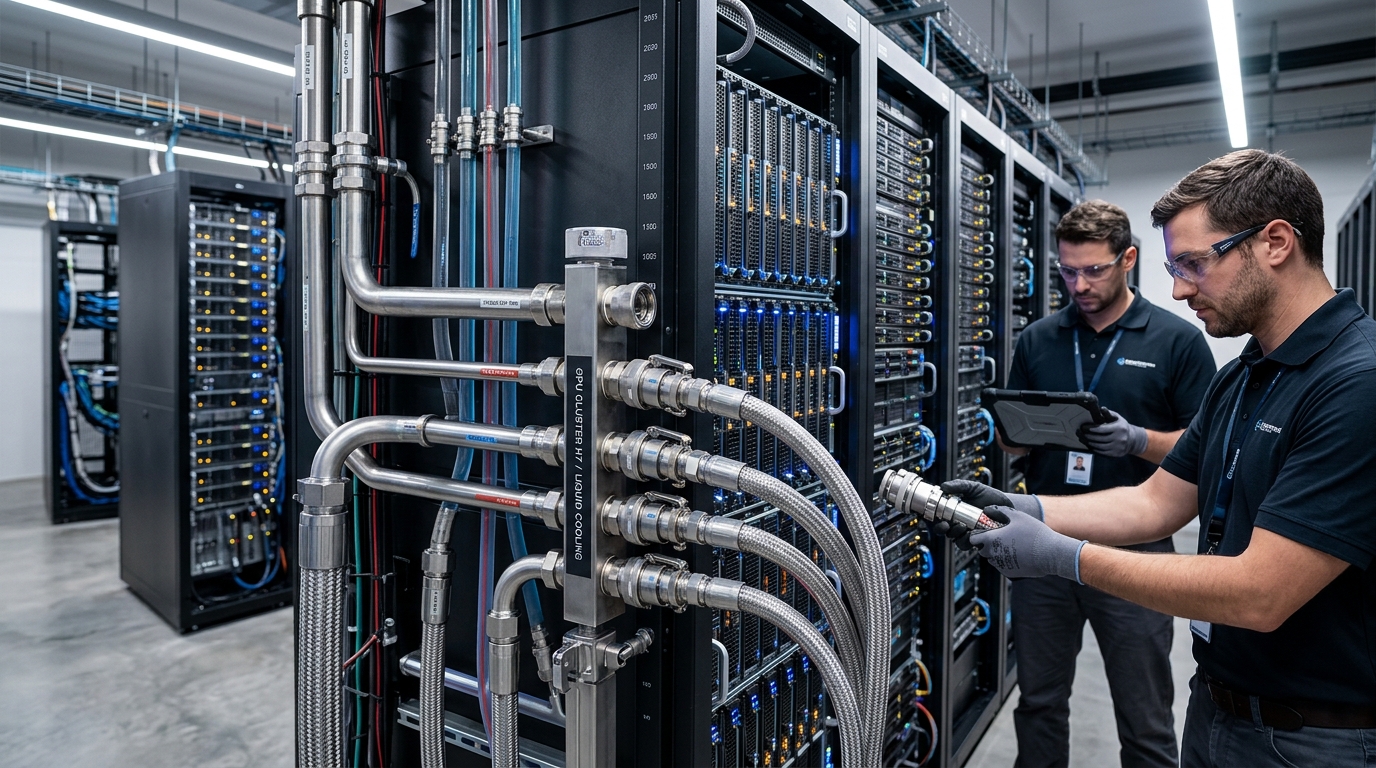
Within that liquid loop, the bottleneck is narrower than most equity frameworks capture. Every rack requires manifolds, quick-disconnect couplings at each node, and facility-level piping connecting rack to chiller. A GB200 rack uses more than 100 UQDs; each must zero-drip-disconnect, last 5,000-plus cycles, with low pressure drop and high flow. Five suppliers control roughly 63-73% of that market: Stäubli, Danfoss, Parker Hannifin, Colder Products Company, and Gates Corporation. Quick-disconnect couplings for liquid cooling are not commodity fittings. They must handle deionized water, glycol mixtures, and in some deployments dielectric fluids, across a wide operating temperature range and typical working pressures measured in single-digit bar. Qualifying a new supplier takes years. This is not commodity plumbing.
Georg Fischer: The Order Signal
Swiss piping vendor Georg Fischer saw year-on-year orders for direct-to-chip liquid cooling systems double in the first half of 2026. Innovations included an energy-balancing valve for precise temperature control, and LiquidCore, which combines GF’s polymer piping, valves, and instrumentation in prefabricated modules. GF launched its LiquidCore system for liquid-cooled data centers in November 2025. The company has also entered several multi-year supply agreements with some of the largest customers in the semiconductor industry, securing a record level of committed orders for multiple fabs.
What M&A Multiples Say
The M&A data tells the structural story. Eaton closed its $9.5 billion acquisition of Boyd Thermal on March 12, 2026. Eaton previously said the price represented 22.5x Boyd Thermal’s estimated 2026 adjusted EBITDA. Ecolab entered into an agreement to acquire CoolIT Systems in March 2026 and later closed the transaction, and Schneider Electric acquired a controlling interest in Motivair. The premium valuation reflects the scarcity of hyperscaler-qualified, scaled liquid cooling manufacturers and Boyd’s durable installed base across North America, Europe, and Asia.
Modine’s Numbers Define the Duration
Modine reported a 47% sales increase in Q4 FY2026, with data center segment sales growing 158% in Q4 alone. Data Center sales surged 73% to cross the $1.1 billion mark for the full fiscal year. Data Centers grew to 35% of fiscal 2026 sales, and Modine signed a long-term capacity agreement with a strategic data center customer, receiving a $165 million upfront deposit and expecting to sell more than $4 billion of data center cooling products during calendar 2027-2029. That is contracted revenue at a supplier to the suppliers, validating the duration of the buildout.
Where the Margin Risk Sits
Gross margin of 23.0% was 190 basis points lower than the prior year, primarily due to higher temporary costs related to the capacity expansion for data center products and higher material costs and tariffs. Parker Hannifin reported record quarterly sales, a record backlog of $12.5 billion, and raised its organic sales growth and adjusted EPS guidance for fiscal 2026, but AI cooling is offsetting softer traditional industrial demand rather than adding purely incremental margin.
Scenario Modeling
- Bull: AI capex extends through 2027, GF LiquidCore adoption expands to colocation operators, and UQD suppliers gain pricing power as qualified supply lags demand. Watch Parker Hannifin (PH), Modine (MOD), and Georg Fischer (FISAN) on backlog commentary.
- Base: Growth normalizes at 30-50% annually; margin pressure persists through mid-2027 as Eaton and Vertiv absorb acquisitions without disruption. Vertiv’s backlog stood at $15.0 billion as of December 31, 2025, up 109% year-over-year, with a book-to-bill ratio of about 2.9x.
- Bear: A hyperscaler delays commitments, qualified Asian UQD entrants disrupt pricing, and Modine’s gross margin falls below 20% on tariff escalation. The tell in every scenario is book-to-bill commentary on Vertiv and Eaton earnings calls.
Backlog conversion, not GPU shipment data, defines this trade. The companies controlling precision fluid components qualify slowly and price firmly. That is not a liability. It is the moat.