The most consequential development in semiconductor manufacturing right now is not a product launch or an earnings beat. It is a conversation that nobody has officially confirmed beyond two words on X.
On October 3, Elon Musk responded to Tim Culpan’s reporting in Culpium that TSMC is exploring ways to work with Terafab to help the startup chipmaker run its new semiconductor factories in Texas. Musk’s reply: “Just discussions, but something may come of it.” TSMC has not commented publicly. That silence is already saying something.
The market read it immediately. TSMC’s New York-listed ADR rose about 3% on Friday, trading as high as $474.79 before closing at $472.78. Hours later in Asia, TSMC’s Taiwan-listed shares climbed about 3% as buyers returned to AI-related names.
What Terafab Actually Demands
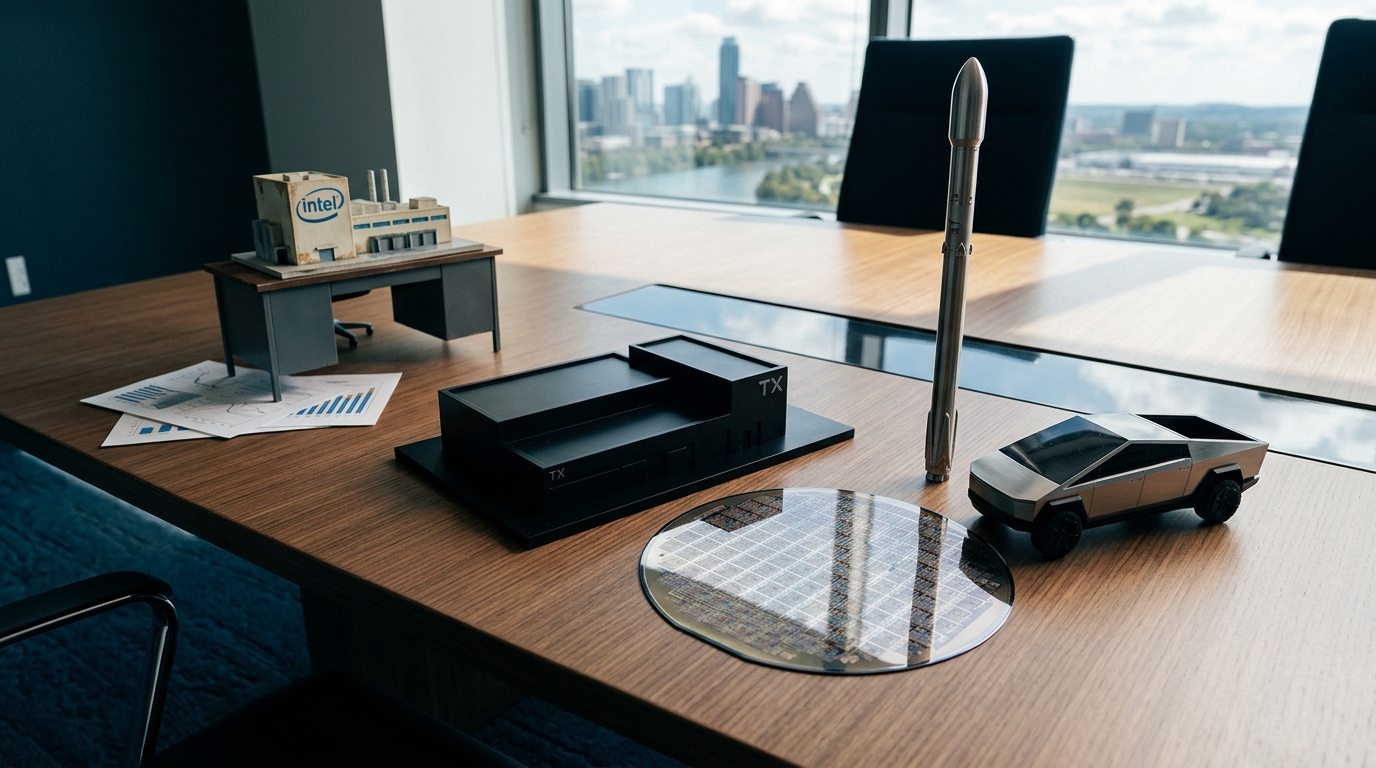
Terafab is a project involving Musk’s companies Tesla, SpaceX, and xAI. The companies have put the initial phase at roughly $16.8 billion and said the finished site will span more than 100 million square feet, which they are calling the largest chip manufacturing facility on the planet. The ambition is singular in a literal sense: Tesla, SpaceX, and xAI are to be supplied to a much greater extent by their own or dedicated chip manufacturing. No external customers, no shared capacity, no foundry economics spread across a dozen fabless clients.
That is precisely what makes TSMC’s interest so striking, and so strategically complicated.
Terafab’s push for vertically integrated manufacturing clashes with TSMC’s pure-play foundry model, which is built around serving fabless customers such as Nvidia, Apple, AMD, and Broadcom. The foundry’s edge has always come from pooling volume across hundreds of chip designs. A single-customer plant breaks that logic. Analysts note that if a deal materializes, TSMC would deviate from its traditional operating model, tying investment outcomes closely to Musk’s execution timeline and Tesla’s financial condition.
The structure Culpan considers most probable is closer to TSMC’s joint ventures in Japan and Germany than to anything resembling full dedication. In that scenario, TSMC would own and operate a dedicated fab complex in Texas with Terafab as an anchor customer, while Musk’s companies provide capital, long-term chip volume commitments, or both. From TSMC’s perspective, the preferred path could be to fold Terafab into its own Texas expansion, with Musk as a major anchor customer rather than handing over manufacturing control.
The Intel Problem
This is where the story turns pointed. Intel announced on April 7, 2026, that it would join the Terafab project. Musk later said Terafab would use Intel 14A, the 1.4nm-class node Intel has been positioning as the moment its foundry business finally lands big outside customers.
That customer win mattered enormously for Intel’s credibility. The story is still missing its most important announcement: a major outside customer publicly committing to 14A, Intel’s next manufacturing process. Intel has told investors it expects early design commitments to start emerging in the second half of 2026 and expand into early 2027. The Fortinet deal announced in July, while real, was on Intel 4, a mature node, less advanced and established for simpler chips called ASICs for networking. Intel Foundry still incurred a $2.089 billion operating loss in Q2 2026, though that improved from a $3.168 billion loss a year earlier.
Intel is set to supply its 14A process technology to Terafab, which would produce chips for SpaceX, Tesla, and xAI. If TSMC becomes involved, then Intel’s 14A could drop out entirely because TSMC would bring its own node. Nor should this be taken as evidence that Intel is being replaced; the information currently available allows only the conclusion that Terafab is in discussions with TSMC and that Intel was previously named as a partner. But the uncertainty itself does damage. A foundry business trying to convert roadmap credibility into signed volume commitments cannot afford ambiguity about its anchor relationship.
Why TSMC Keeps Winning This Argument
The Texas conversation also lands on top of TSMC’s existing U.S. buildout. In July 2026, TSMC announced an additional $100 billion investment that brings its total planned Arizona spending to $265 billion. The potential Texas investment would be in addition to that $265 billion commitment. The Arizona money funds four additional fabs, bringing the planned total to ten, and the company has said those new fabs are planned for 2-nanometer or more advanced production.
A company posting those kinds of numbers can afford to experiment with new partnership structures. It can absorb the dilution to its model that a single-customer plant represents, especially if that customer is committing volume at the scale Musk has described. Terafab has been pitched with an initial target around 100,000 wafer starts per month, with ambitions to scale to 1 million at full capacity, a level that analysts have said would be on the order of roughly 70% of TSMC’s current monthly output.
Those numbers will not be achieved. The timelines will slip. The capital will be contested. But even a fraction of Terafab’s stated demand, secured as guaranteed volume behind TSMC process technology, changes the economics of a Texas campus that TSMC was already considering on its own terms.
For long-term investors, the issue is not whether a deal gets signed this quarter. The issue is that the world’s dominant foundry is now competing for the anchor position in the most ambitious private semiconductor project ever announced, and Intel’s 14A window to prove it belongs in the same sentence just got narrower.