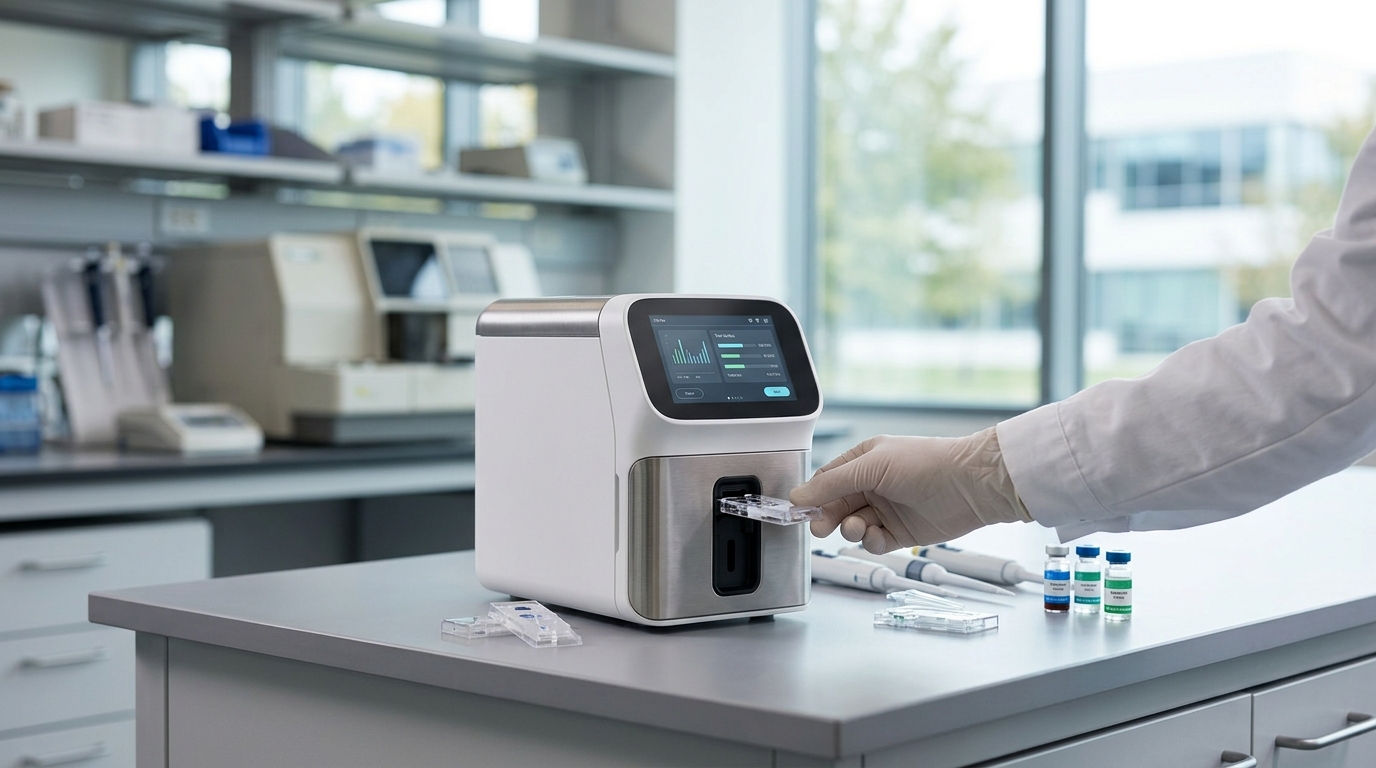
The central hospital lab, with its room-sized analyzers and hours-long turnaround, is not going away tomorrow. But the economics underneath it are shifting fast, and disciplined traders should be studying the gap between where microfluidic diagnostics are now and where the capital says they are heading.
The medical microfluidic devices market is forecast by Research and Markets to grow from $7.32 billion in 2026 to $12.79 billion by 2030, roughly a 15% CAGR. That is not a slow-growth healthcare story. That is a compression trade, the kind where a capability that once required specialist infrastructure migrates to a single-use cartridge you can run in a clinic waiting room.
What the Technology Actually Does
Microfluidic diagnostics encompasses miniaturized analytical technologies that manipulate very small volumes of biological fluids within engineered channel architectures to achieve rapid, integrated detection of pathogens, biomarkers, and nucleic acids. Put plainly: some biological work that once demanded a centrifuge, a trained technician, and a long turnaround can now fit inside a cartridge the size of a credit card.
A peer-reviewed microfluidic digital immunoassay method has reported NT-proBNP measurement from whole blood in about 10 minutes using 7 microliters of blood. Seven microliters. A finger-stick delivers that. The platform wall between hospital and patient is dissolving, one cleared cartridge at a time.
Where Regulators Are Clearing the Path
FDA clearances in 2026 tell you which companies converted lab innovation into commercial product. FDA device databases show Abbott Point of Care received 510(k) clearance on June 11, 2026 for the i-STAT hs-TnI cartridge with the i-STAT Alinity System, expanding cartridge-based high-sensitivity cardiac troponin testing. FDA records also show Cepheid received 510(k) clearance on January 16, 2026 for Xpert GI Panel, a single-use GeneXpert cartridge test designed to detect 11 gastrointestinal pathogens using 10-color multiplex PCR. Two clearances, two very different disease areas, same underlying logic: consolidate workflow, shrink the sample, speed the result.
How Experienced Traders Read This Sector
The mistake most traders make here is chasing the science headline rather than watching who controls recurring consumable revenue. In an October 2026 market note distributed via GlobeNewswire for a Research and Markets report, microfluidic consumables were described as about 66.7% of the global microfluidics market in 2025, making them the leading product segment. The platform is the moat. The cartridge is the annuity. Companies that have cleared a device and locked in a hospital formulary earn revenue every time a test runs, structurally similar to a razor-and-blade model that compound-growth investors have paid premium multiples for in adjacent device categories.
Funding is moving toward startups that can show faster diagnostic turnaround times, reduced sample requirements, and strong integration with healthcare systems. Startups that remain in early research stages without clear clinical pathways are finding it harder to attract attention, as the market now favors execution over experimentation. That bifurcation between cleared and pre-cleared companies is where relative strength trades emerge.
The Trader’s Lesson
A technology category hitting about 15% annual growth and simultaneous regulatory clearances from two major players is not an early-stage bet anymore. It is a scaling story with a clear valuation question: which companies control the cleared platform, own the consumable stream, and have a hospital distribution channel that competitors cannot replicate cheaply. Identify those three variables before you size into anything in this space. The science is not the edge. Knowing who monetizes it is.