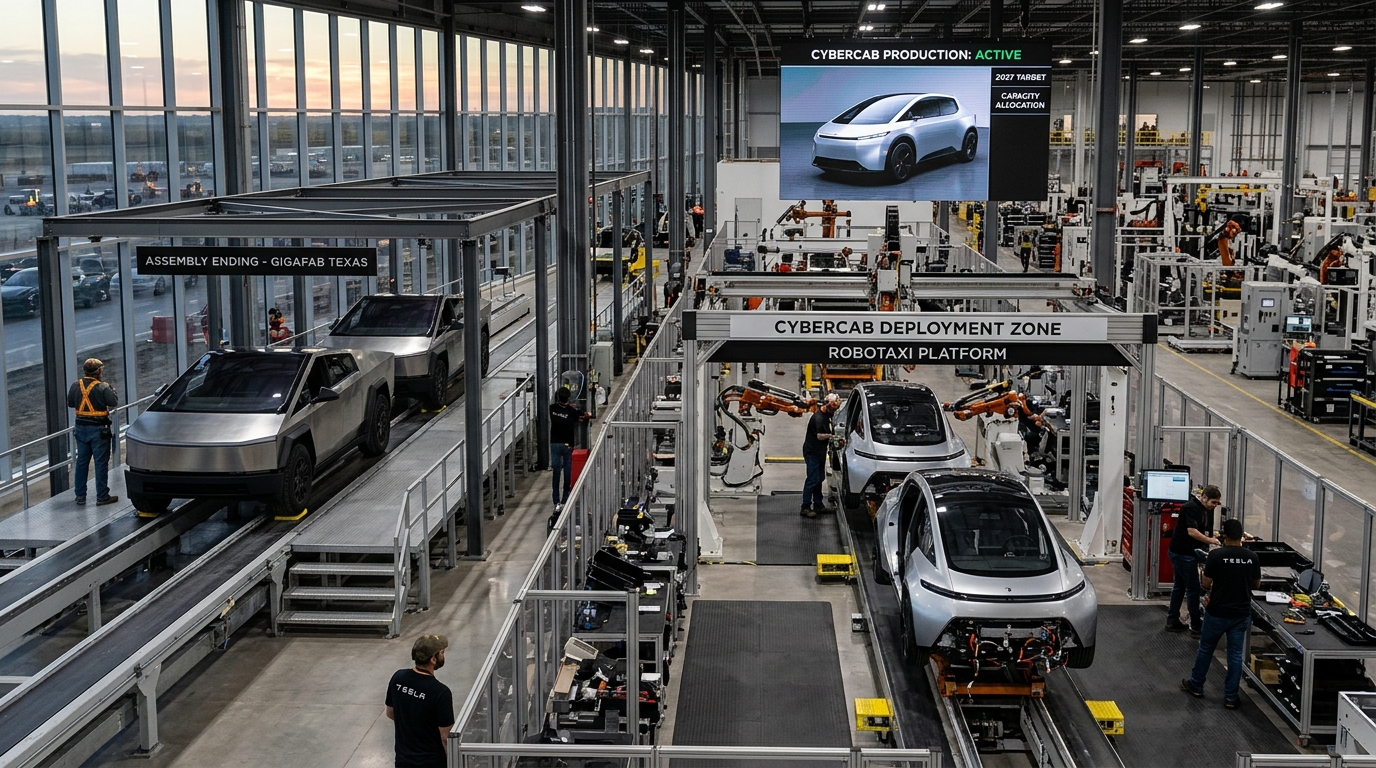
Tesla has never killed a car before. Friday changed that. Elon Musk confirmed on X that Cybertruck production at Gigafactory Texas will wind down around the middle of 2027, roughly three years after first deliveries, to free floor space for the Cybercab robotaxi. It is the first product retirement in Tesla’s history, and the market greeted it as a relief rather than a loss.
Tesla rose a little over 4% to about $358 on November 6, while the S&P 500 rose about 0.3% over the same session. The gap tells you something: investors are not mourning the Cybertruck. They are pricing the Cybercab bet.
Why the Cybertruck Was Already Gone
The numbers make the decision easy to understand. The Cybertruck sells at roughly a tenth of the 250,000 units per year Tesla built its line for. Sales were widely estimated at 20,237 vehicles in 2025, and about 11,586 in the first nine months of 2026. By Q3 2026, the truck and Tesla’s other models combined represented under 2% of third-quarter deliveries.
Tesla’s quarterly updates have described installed Cybertruck capacity as over 125,000 units annually. Against actual sales running near 30,000 a year, that is a factory burning cost for a product that stopped growing. The Cybertruck also faced multiple recalls and quality control complaints, while its controversial design was widely derided. Reallocating the floor space is not a strategic pivot. It is an admission.
The Investment Thesis: One Unverifiable Assumption
The bull case for TSLA today rests almost entirely on the Cybercab. Tesla told investors in its Q2 2026 update that Cybercab began production at Gigafactory Texas and that employee rides on the Texas campus began in July 2026. That is progress. The revenue is not, yet.
On timelines, Musk has pointed to robotaxis and autonomy as a bigger 2027 story than a 2026 one, and for investors, those new production milestones sit alongside that more measured timeline. The company has not provided a specific production or sales target for the planned wind-down. Tesla is trading a product with three years of public sales data for one that has posted no volume commitments investors can verify.
Bull Case
Clearing the Cybertruck off the production floor removes a money-losing distraction and accelerates the one product Tesla’s valuation actually requires. Tesla has shown internal planning charts that reach into the millions of Cybercabs per year. If the company reaches even a fraction of that at scale, the Cybertruck’s absence means nothing. Musk has said he expects robotaxi revenue to start showing up in results in 2027, which at least aligns the timelines.
Bear Case
The Cybertruck missed its original price target by more than $20,000. Traders remain skeptical that Tesla can deliver a Cybercab to a customer at its promised price on the timeline it has suggested. At about $358, the stock trades at a multiple that leaves almost no margin for another product that arrives late, costs more than promised, or scales slowly. Musk’s pattern on ambitious timelines is well documented.
What Investors Should Watch
The next Tesla earnings call will be the first real test. Watch for a Cybercab production number, not a fleet size or a miles-driven metric. Volume deliveries, not rides, are how you scale a vehicle business. Nobody knows how many Cybercabs Tesla will build or sell, and the stock’s price depends far more on that than on the Cybertruck.
Ford and GM are not standing still on autonomous programs. Rivian carries its own factory constraints. But none of that matters if Tesla cannot answer the one question Friday raised: how many Cybercabs, and when?
Bottom line: Ending the Cybertruck is the right call, and the market was right to treat it as one. The harder question is whether the Cybercab assumptions now baked into TSLA’s valuation can survive contact with an actual production ramp. That answer does not arrive until 2027.