The market is selling off today. Oil is up more than 5%. The Dow dropped 540 points at the open after President Trump declared the U.S.-Iran ceasefire over at the NATO summit in Ankara. Bond yields moved higher. It is, by any reasonable measure, a risk-off morning.
And yet, quietly — almost invisibly against that backdrop — Apple just dropped the most significant supply chain announcement in its history.
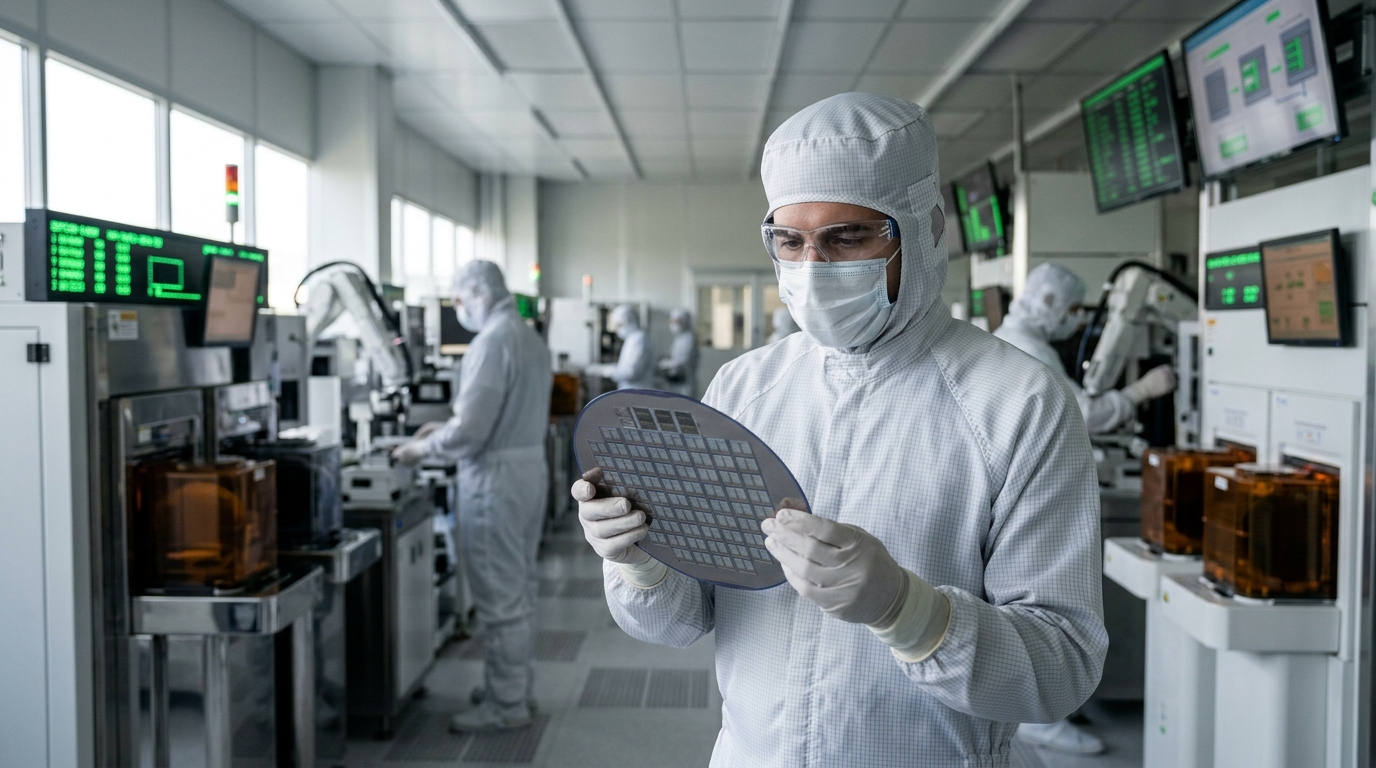
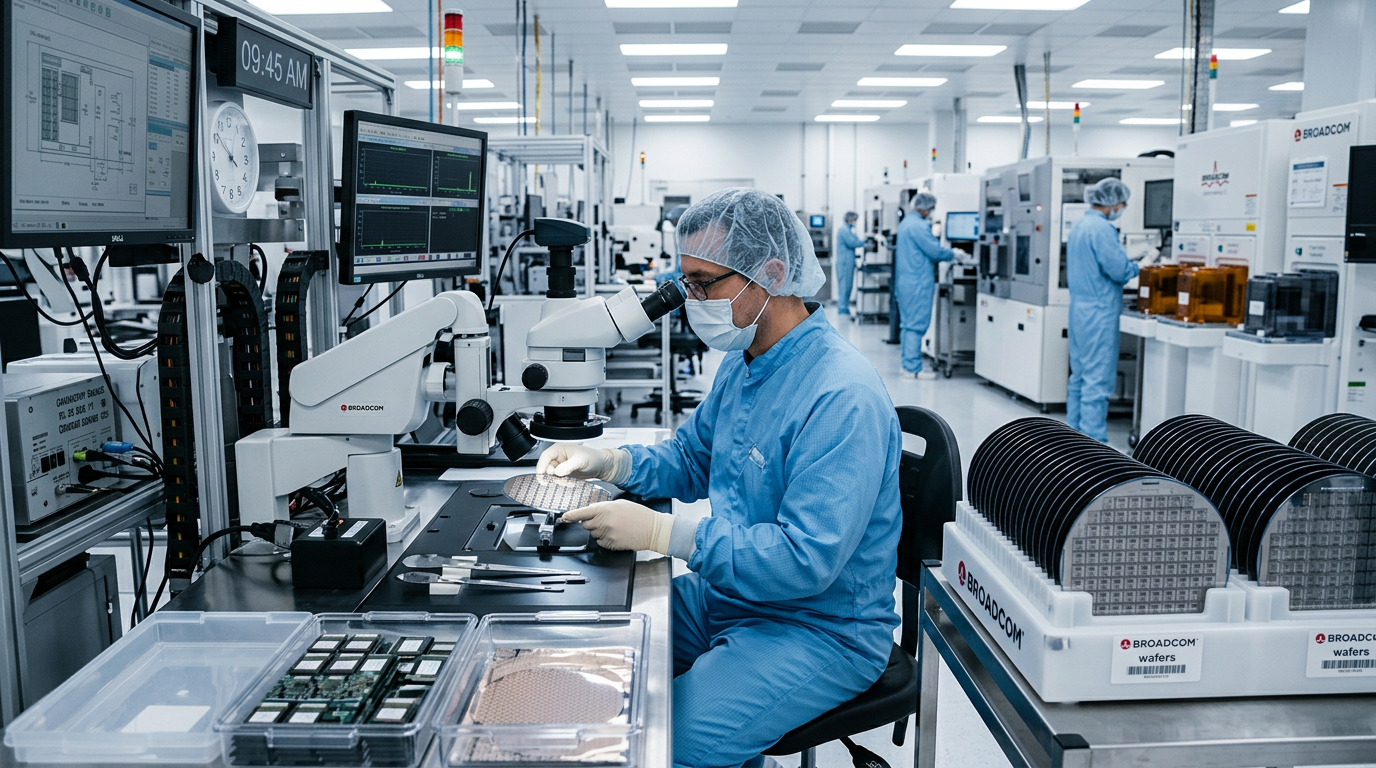
This morning, Apple officially confirmed a multi-year agreement with Broadcom worth more than $30 billion, spanning multiple product generations through 2031, covering custom ASIC silicon and next-generation wireless connectivity technologies. The deal commits to production of over 15 billion U.S.-made chips and includes a $1.5 billion capital expansion of Broadcom’s manufacturing facility in Fort Collins, Colorado.
Broadcom (AVGO) is currently trading around $370. Its 52-week high is $495. That is a 25% discount to peak, on the same day its largest confirmed revenue anchor just became public knowledge.
That is the story today.
What Actually Happened
Two things happened in sequence. On July 6, Broadcom filed an 8-K with the SEC confirming the extension of its technology collaboration with Apple through 2031, covering custom ASIC silicon products for multiple future generations of Apple hardware. Shares climbed roughly 4-6% in premarket trading on the filing alone. Then this morning, Apple published the formal press release from Cupertino confirming the dollar figure: more than $30 billion, the largest commitment ever made under Apple’s American Manufacturing Program.
The $1.5 billion Fort Collins expansion is not cosmetic. That facility produces advanced radio frequency components — specifically FBAR filters — along with Wi-Fi and Bluetooth connectivity technology that goes into every iPhone, iPad, and Mac shipped globally. This is not discretionary spending. Apple cannot build a phone without these parts.
What the SEC filing added that the press release skims over: the contracts cover custom ASIC silicon products for multiple future Apple product generations. ASIC means application-specific integrated circuit. These are the specialized chips Apple uses for AI inference, on-device processing, and tasks where off-the-shelf silicon from anyone else would be slower, hotter, or more power-hungry. The extension of that ASIC relationship through 2031 is, frankly, the more significant number — because it is the revenue stream that compounds as Apple Intelligence scales into more products.
Why the Valuation Gap Exists
Broadcom reported its fiscal second quarter on June 3. The headline numbers were strong. Revenue came in at $22.19 billion, up 48% year over year. AI semiconductor revenue hit $10.8 billion in the quarter alone — up more than 100% from a year ago. The company guided Q3 AI semiconductor revenue to approximately $16 billion, implying more than 200% year-over-year growth. Management reiterated its target of $100 billion or more in AI semiconductor revenue by fiscal year 2027.
The stock fell 14% after earnings.
That is not a typo. Broadcom posted 48% revenue growth, guided to more than 200% AI chip growth in the next quarter, and the stock dropped double digits in a single session. The market was expecting the company to raise its full-year $100 billion AI revenue target. It did not. Analysts who had modeled upward revisions got flat guidance, and they punished the stock accordingly.
Here is what matters for active traders today: the post-earnings selloff pulled AVGO from an all-time closing high near $481 in early June to the current range around $370. That is a 23% correction in roughly five weeks. The correction was not driven by deteriorating fundamentals. It was driven by an expectations miss — the market wanted more than $100 billion, and got confirmation of exactly $100 billion. Gross margin guidance also came in slightly softer than some expected, moving toward 74% from north of 77%, as the product mix shifts further toward AI chips, which carry lower margins than connectivity components.
The $30 billion Apple commitment announced today does not fix the margin debate. What it does is settle the revenue visibility question definitively. Apple accounts for approximately 20% of Broadcom’s annual revenue. A five-year locked agreement worth more than $30 billion, covering both RF components and ASIC silicon, represents something that almost no other company in the semiconductor sector can point to: a confirmed revenue floor stretching nearly to the end of the decade.
The Supply Chain Read-Through
Slight tangent, but it matters. The Apple announcement today is not just a Broadcom story. Apple’s American Manufacturing Program — which this deal falls under — includes a roster of partners that investors have mostly underpriced relative to the volume of commitments involved.
Corning (CLW), GlobalFoundries (GFS), and Texas Instruments (TXN) are all named participants in the AMP initiative alongside Broadcom. Amkor Technology is another. These companies are receiving capital flows tied directly to Apple’s stated $600 billion U.S. investment commitment. Apple has already sourced more than 20 billion U.S.-made chips from 24 factories across 12 states under this program since its launch. In 2026 alone, the company is on track to purchase well over 100 million advanced chips from TSMC’s Arizona fab.
GlobalFoundries, specifically, is developing and manufacturing cellular semiconductor components with Apple under AMP. Texas Instruments received incremental tool installations at its Lehi, Utah facility and a new Sherman, Texas site through the same initiative. Amkor broke ground on a $7 billion semiconductor packaging facility in Peoria, Arizona — with Apple as its first and largest committed customer.
This is an end-to-end domestic silicon supply chain being assembled in real time. Apple is the anchor customer for most of it. Broadcom gets the headline today, but the capital flows ripple across at least a half-dozen other names that are significantly less crowded from a positioning standpoint.
The Competitive Landscape
The ASIC business is where Broadcom’s most interesting long-term positioning sits. Custom AI chips — what Broadcom calls XPUs — offer 30-50% lower total cost of ownership versus Nvidia GPUs for specific workloads at hyperscaler scale. They are not a replacement for Nvidia. They are a complement that allows the largest buyers of compute to optimize cost at the production inference layer while using Nvidia for research and general-purpose workloads.
Broadcom’s confirmed ASIC customers now include Google (TPU accelerators), Meta (MTIA accelerators), OpenAI (whose custom inference chip was unveiled in June), Anthropic (1 gigawatt of TPUs deployed in 2026, scaling to 3 gigawatts in 2027), and with today’s announcement, Apple confirmed explicitly as a custom ASIC partner. Six core custom chip customers generating AI semiconductor revenue projected at $100 billion or more by fiscal 2027.
The primary competitor in this space is Marvell Technology (MRVL). Marvell has design wins with Amazon and Microsoft and is projected to grow its AI ASIC revenue to somewhere between $9 and $11 billion in 2026. That is meaningful growth — but still roughly a quarter of Broadcom’s scale in the same category. Marvell also lacks Broadcom’s networking portfolio, which creates what one analyst framed as a “multiplier effect” on each customer engagement. When Broadcom sells a hyperscaler an ASIC, it also sells the networking chips required to connect the ASICs into a coherent compute cluster. Marvell does not have that full-stack presence at equivalent scale.
Worth watching: Marvell’s positioning with Microsoft and Amazon makes it the most direct second-order beneficiary of the AI ASIC buildout if traders want to look one step removed from the Broadcom-Apple headline.
Technical and Market Structure
AVGO is currently trading around $370, which puts it roughly in the middle of its 52-week range between $269.58 and $495.00. The stock is above its 200-day moving average. It broke below the $400 level after the June 3 earnings report and has not reclaimed it since.
The key levels to watch: $400 is the near-term resistance level — the price at which the stock spent much of May before the earnings-driven selloff. A reclaim of $400 on meaningful volume would signal that the market is beginning to reprice the Q3 AI revenue guide of $16 billion rather than dwelling on the unchanged full-year target. Below current levels, the $350 zone represents the next structural support where the stock consolidated briefly in March before its spring rally.
Volume context matters here. The post-earnings decline came on heavy volume — institutional selling in size. The subsequent stabilization in the $370-$390 range has come on lighter volume, which is consistent with distribution completing and a new buyer base forming rather than continued aggressive selling. The $30 billion Apple announcement today provides a fundamental catalyst that could accelerate that transition if broader market conditions stabilize.
The broader market context complicates the picture. With the Dow down 540 points, oil surging on Strait of Hormuz closure fears, and Treasury yields rising, risk appetite is compressed across the board. AVGO is unlikely to mount a sustained technical recovery on a day when the macro is working against every risk asset. What the Apple deal does today is change the fundamental floor — the technical move may come later, potentially into the September 3 earnings date.
Scenario Modeling
Bull Case
Oil-related market anxiety fades as diplomatic channels reopen between the U.S. and Iran — which Trump left open explicitly at the NATO summit by saying peace talks can continue even as military pressure resumes. If Brent crude retreats from its current $78 level and broader risk sentiment recovers, AVGO rerates back toward the $420-$440 range as Q3 AI semiconductor revenue of $16 billion gets priced in. The $30 billion Apple anchor eliminates the bear case argument that AI ASIC revenue is concentrated or fragile. Analysts begin raising price targets from the current $490-$545 consensus range toward $600+. The September 3 earnings catalyst becomes a potential breakout event if Broadcom shows expanding customer revenue per ASIC engagement.
Base Case
Geopolitical noise keeps a lid on the broader market through July while AVGO consolidates between $360 and $400. The Apple deal gets processed as incrementally positive — confirming what the SEC filing already implied — but does not produce a sustained breakout in a risk-off tape. Q3 earnings on September 3 become the next major inflection point. Broadcom continues to compound revenue at the 40-50% year-over-year rate, gross margin stabilizes as the product mix settles, and the stock grinds back toward $420 into year-end. The valuation — currently somewhere between 55 and 65 times forward earnings depending on the estimate used — remains a friction point for incremental buyers.
Bear Case
The Iran conflict escalates meaningfully, pushing oil through $85 and triggering a broader de-risking event across equities. Technology and semiconductors, as high-beta sectors, underperform in that environment. AVGO revisits the $340-$350 support zone established in late March. Simultaneously, margin pressure in the AI ASIC segment proves more persistent than guided, and Broadcom’s gross margin falls below 74%. Customer concentration — with Apple at 20% of revenue — becomes a liability narrative if Apple Intelligence adoption disappoints heading into the iPhone 18 cycle. In this scenario, the September 3 earnings report arrives with a more difficult setup than current consensus implies.
Active Trader Framework
A few things worth thinking through before acting on today’s news.
First, position sizing matters more than entry point in a day where the macro is moving against the trade. Taking a smaller starter position in AVGO near $370 and adding on confirmation of a $400 reclaim is a more disciplined approach than sizing for a full position into a risk-off market session. The fundamental case is intact. The technical confirmation is not yet here.
Second, the options market is worth monitoring. Implied volatility on AVGO has been elevated since the post-earnings drop in June. If IV contracts as the Apple deal gets absorbed as genuinely positive — rather than neutral — that compression itself creates value for long-biased positioning. The September 3 expiration cycle is the most interesting window for options traders thinking about the next earnings catalyst.
Third, the AMP supply chain names deserve a separate look. GlobalFoundries and Texas Instruments are both much less crowded than AVGO from a positioning standpoint. They benefit from the same Apple commitment without carrying the valuation multiple that Broadcom trades at. The tradeoff is less direct AI semiconductor exposure and lower growth rates — but for traders looking for a less-crowded expression of the same thematic, those names are worth the research time.
Finally: the Fed. The June policy meeting minutes drop today at 2:00 PM ET. The readout will be the first from a meeting chaired by Kevin Warsh, and analysts expect clarity on the conditions under which the Fed would feel compelled to raise rates further. A hawkish read-through on top of the geopolitical noise would add another headwind to the semiconductor trade specifically — these are long-duration growth assets and they reprice in both directions when rate expectations shift.
What This All Means
Broadcom now has confirmed, named, multi-year revenue relationships with six of the largest AI compute buyers on earth — Google, Meta, OpenAI, Anthropic, Apple, and a sixth customer not yet publicly identified — plus a $30 billion manufacturing anchor that extends through 2031 as its single largest revenue contributor. AI semiconductor revenue is growing at more than 100% year over year and guided to accelerate further in Q3.
The stock is down 25% from its peak.
That gap exists because the market priced perfection in May, got confirmation rather than acceleration in June, and has been unwilling to pay the original multiple in the months since. The Apple announcement today is the first genuinely new information to arrive since that earnings-driven reset — and it is not small information. A $30 billion contracted revenue commitment from Apple, locked through 2031, is precisely the kind of visibility that long-duration investors require before they reset their cost basis higher.
Whether today is the right entry depends on risk tolerance, timeline, and macro conditions that are, frankly, unusually difficult to read right now. What is not difficult to read is the fundamental story: Broadcom has become the toll booth at the intersection of AI infrastructure and consumer electronics, and the largest customer just signed a five-year renewal for the right to use it.
The September 3 earnings date will tell us a lot more. Watch the $400 level between now and then.
For informational and educational purposes only. Not investment advice. Trading involves risk, including loss of principal.