Goldman Sachs raised its 12-month target for the MSCI AC Asia Pacific ex-Japan Index to 1,120 from 1,080 this week, implying 26% upside, with Korea and Taiwan leading the earnings revision that drove the call. The number is striking. The reasoning behind it is more important than the number itself.
Second-quarter earnings across the index grew 102%, with 44% beats against 27% misses, led by Singapore, Taiwan, and Indonesia. Strip the headline away, though, and the picture narrows fast. As of early June the index was up 27% year-to-date. Remove South Korea and Taiwan, and the rest of the region was actually down 4%. This is not a broad Asian bull market. It is two countries manufacturing the physical infrastructure of artificial intelligence, and every other market riding in the slipstream.
What the Hardware Cycle Actually Looks Like
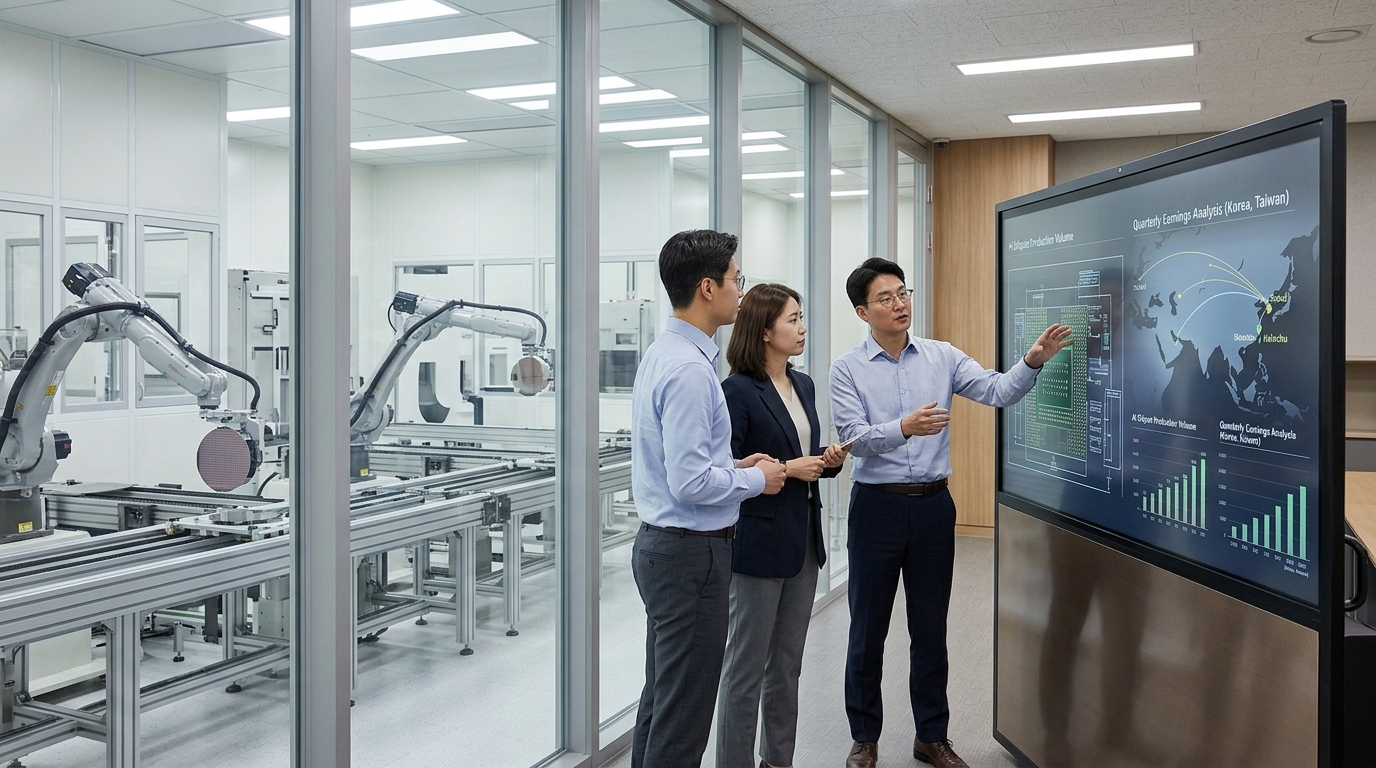
Taiwan’s semiconductor ecosystem, anchored by foundries producing advanced logic chips for AI training and inference, functions as a linchpin of global technology supply chains. TSMC’s advanced-node capacity was forecast by Goldman to remain tight through 2026 and 2027, and Goldman expects Taiwan Semiconductor to invest over $150 billion in capital expenditures between 2026 and 2028 to meet surging AI chip demand.
Korea’s story runs through memory. Samsung Electronics and SK hynix together posted about 150 trillion won in operating profit in the second quarter of 2026 alone. SK hynix is on pace to earn more profit in 2026 than it generated across the previous 27 years combined, a reflection of how central its high-bandwidth memory chips have become to AI infrastructure led by buyers like Nvidia. Goldman’s strategist Timothy Moe, reiterating the bullish Korea stance as recently as this summer, argued that the surge in demand for memory chips is expected to extend through 2028 and beyond.
The Valuation Puzzle Worth Solving
The profits are real. The valuations assigned to them are where long-term thinking becomes essential. Samsung and SK hynix are expected to see net profits surge sharply this year, far exceeding TSMC’s growth of around 50%, yet their forward price-to-earnings ratios have been sitting in the mid-single digits, well below the valuations commanded by TSMC and Nvidia.
The market is essentially pricing in cyclical bust as the base case even as the cycle posts supercycle numbers. That creates exactly the kind of tension a patient capital allocator wants to examine. Charlie Munger’s version of the question would be simple: is the business earning these returns on durable competitive advantages, or on a temporary scarcity that new capacity will eventually eliminate?
What Could Go Wrong
Memory chips have a long history of boom-bust cycles, and Goldman’s call that this one extends through 2028 is explicitly a bet that AI demand growth will outpace capacity additions for at least two more years. That is a specific forecast, not a law of physics.
Concerns that AI infrastructure spending may be peaking faster than expected have already rattled the sector once this year. Investors remain alert to the possibility that major technology companies could scale back AI infrastructure spending, weighing on future chip and memory demand. Washington has also entered the picture: in a meeting reported in mid-July 2026, an industry source told The Korea Times that a deputy US Trade Representative floated the idea that the United States deserved a share of the massive profits of Samsung and SK hynix, a reminder that extraordinary profits in strategically critical industries attract political attention.
The Long-Term Verdict
Goldman’s upgraded target is a short-term price call. The durable question is structural: TSMC owns the logic layer, the bottleneck where margin is widest and substitution is hardest. Samsung and SK hynix own the memory layer, where pricing has historically been brutal when supply catches demand. The AI cycle may extend the good times. It does not change the underlying competitive geometry.
Investors who approach Korea and Taiwan as a single AI trade miss that distinction entirely. The two countries manufacture the same revolution. They do not necessarily keep the same share of its economics.