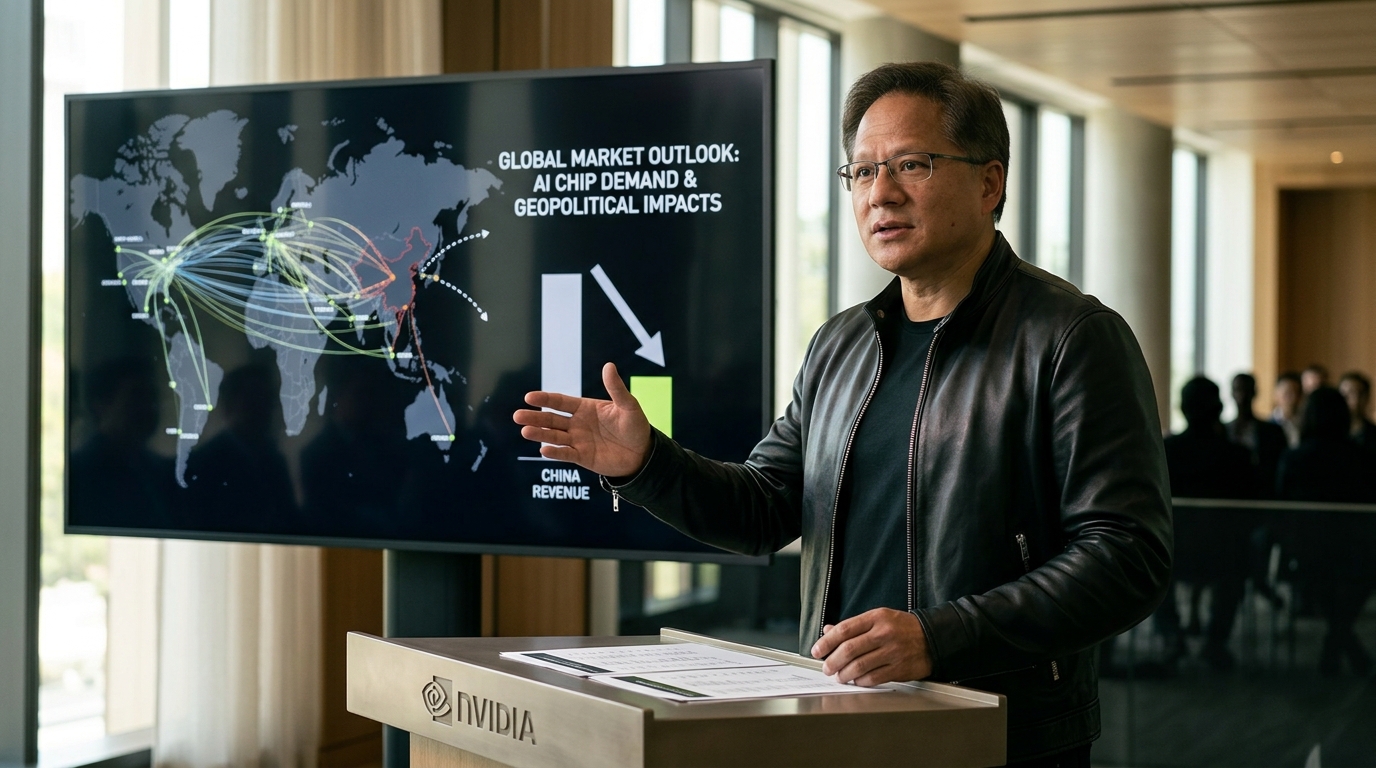
Jensen Huang has been saying it for two years. Nvidia’s CEO has repeatedly criticized Washington’s export restrictions, arguing they are effectively handing China’s roughly $50 billion AI chip market to local competitors such as Huawei. On October 13, the first hard market data arrived to test that claim, and the claim held up.
According to an IDC report seen by Reuters, Nvidia’s share of China’s market for data-centre AI chips fell to 34% in the first half of 2026. The company shipped 678,000 AI accelerators in China from January through June, down 44% from a year earlier. Huawei shipped 572,000 AI accelerators, up from more than 300,000 a year earlier, giving it a 28% share of the overall market. Six percentage points now separate the two. That gap was insurmountable eighteen months ago.
The Revenue Picture Is Worse Than the Share Numbers Suggest
Market share is a volume story. The revenue story is sharper. Nvidia’s fiscal Q1 2026 earnings call made clear that new U.S. export controls had effectively ended its Hopper data center business in China.
At Nvidia’s March 17, 2026 annual meeting of stockholders, Huang said China’s revenue contribution had fallen to roughly 9%. Three years earlier, China had accounted for at least one-fifth of Nvidia’s data center revenue. In other words, Nvidia’s China revenue has contracted from billions of dollars in annual contribution to near zero.
Nvidia said it is not assuming any data center compute revenue from China in its forward outlook. That statement answers one question and raises another: if China is officially excluded from guidance, how much of the bull case still rests on China eventually returning?
What the Domestic Ecosystem Is Becoming
The more uncomfortable finding in the IDC data is not Huawei’s 28% share alone. It is the breadth of domestic substitution forming behind it. Cambricon sits at 5%, Baidu’s Kunlunxin at 4%, and Hygon at 3%. Nine of the 11 Chinese chipmakers tracked by IDC increased shipments year on year. Shipments of non-GPU AI chips surged nearly 80%, surpassing GPUs in volume for the first time.
IDC noted that the competitive focus is shifting from standalone chip performance to overall system capability. That shift matters because Nvidia’s moat in China was always partly architectural, the CUDA software ecosystem locked customers into its hardware. A market that has spent 18 months building inference stacks around Huawei’s Ascend and domestic accelerators is not simply waiting for Nvidia to come back.
The Forward Earnings Question
In its FY2026 annual filing, Nvidia acknowledged: “Under the current rules and geopolitical landscape, we are unable to create and deliver a competitive product for China’s data center market that receives approval from both the USG and the Chinese government.” The filing went further, stating that Nvidia was “effectively foreclosed from competing in China’s data center computing/compute market” and that the foreclosure helped competitors build larger developer and customer ecosystems to challenge Nvidia worldwide.
That last clause deserves more attention than it has received. The risk is not just lost Chinese revenue. It is whether a Huawei-led domestic ecosystem eventually pressures Nvidia outside China.
Stocks to Watch
Nvidia (NVDA). Despite a 19% gain in 2026, forward earnings estimates have risen faster, leaving Nvidia trading at roughly 14 times next year’s projected earnings. Analysts maintain a Strong Buy consensus with an average price target around $324. The valuation is defensible if hyperscaler spending outside China holds. The IDC report adds pressure to verify that assumption ahead of the November 17 earnings call.
AMD. Faces the same export control regime in China. Any resolution that reopens the China market benefits AMD’s data center business alongside Nvidia’s, but AMD starts from a lower base and has less China-specific exposure to unwind.
Huawei (unlisted). IDC projects total AI chip shipments in China will rise 19% for full-year 2026, but forecasts GPU shipments will decline 9%. Huawei is the primary beneficiary of that divergence, building scale in the non-GPU accelerator segment where it already commands the market with its Ascend line.