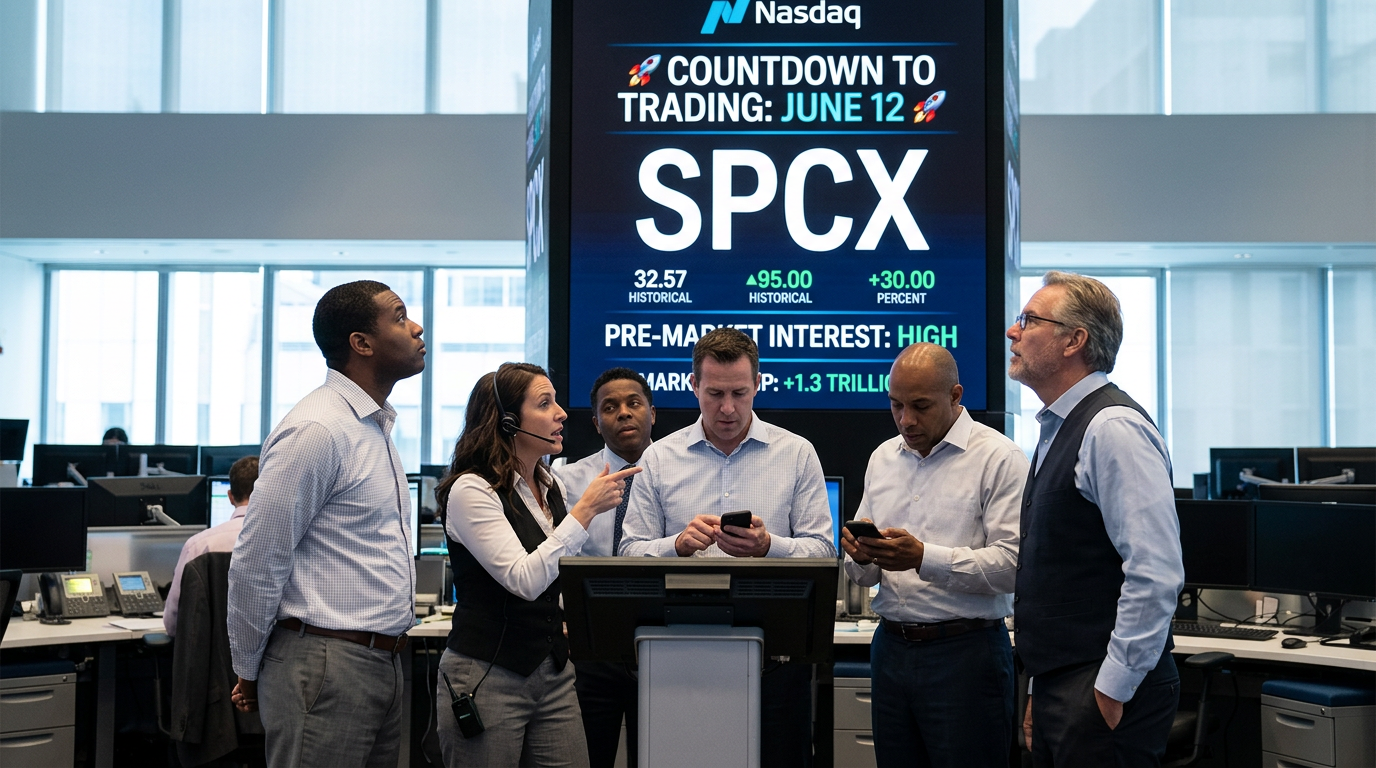
It’s here. After nearly a decade of private market speculation, SpaceX has officially filed its S-1 with the SEC and is targeting a Nasdaq listing under the ticker SPCX — with investor presentations beginning June 4, final pricing on June 11, and public trading expected to begin June 12, 2026.
At a revised floor valuation of $1.8 trillion, this would be the largest IPO in Wall Street history — surpassing Saudi Aramco’s $29.4 billion raise in 2019. The deal aims to raise up to $75 billion. Goldman Sachs, Morgan Stanley, Bank of America, Citigroup, and JPMorgan are leading a syndicate of 23 financial institutions. The sheer mechanics of this deal will ripple across capital markets for weeks.
The Numbers Behind the Name
SpaceX reported $18.7 billion in consolidated 2025 revenue — up roughly 33% year over year. Analyst models project 2026 revenue between $22 billion and $30 billion, with Starlink as the primary growth engine. The satellite internet service has crossed 10 million global subscribers, generated $11.4 billion in 2025 revenue, and posted $3.3 billion in Q1 2026 alone — with a $1.19 billion operating profit for the connectivity segment last quarter.
Here’s where it gets complicated. The company posted a net loss of $4.94 billion in 2025, primarily driven by its AI segment — xAI — which burned through capital at an aggressive pace following its merger with X. The xAI unit spent $7.72 billion in just the first three months of 2026, posting a $2.47 billion operating loss in Q1 alone. Elon Musk retains 85.1% voting control through a super-voting share class. Shareholders buying SPCX on day one should be clear-eyed: governance influence is minimal.
The valuation math is aggressive. At $1.75–$1.8 trillion, the deal implies roughly 109–116 times trailing 2025 revenue. On forward 2026 estimates, the multiple compresses to 58–65 times. For context, Snowflake’s own IPO — which at the time was considered richly priced — came in far below those multiples. Prediction markets on Polymarket currently assign a 90% probability that SPCX’s market cap closes above $1.8 trillion after its first trading day, with 77% odds of closing above $2 trillion.
Why This Is the Most Watched Macro Event in Markets Right Now
The IPO isn’t just a single-stock event. At $75 billion in projected capital raised, SPCX will pull institutional liquidity from across the equity ecosystem during its roadshow and book-building phase. Historically, mega-IPOs of this scale create short-term pressure on secondary market positions as funds rebalance to make room for a new mega-cap. Worth watching: the space sector itself was already volatile this week — AST SpaceMobile (ASTS) fell as much as 18% after Blue Origin’s New Glenn rocket exploded on its launch pad Thursday night, and Rocket Lab slid more than 6%. SPCX’s debut will likely re-rate the entire sector, up or down, depending on first-day price action.
What’s interesting is how SpaceX is framing its identity in the S-1. This isn’t a rocket company pitching investors on satellite internet. The prospectus leans heavily into AI infrastructure, orbital data centers, and a total addressable market that the company itself puts at $28.5 trillion. That’s a deliberate narrative choice — SpaceX is asking to be priced like a next-generation AI and infrastructure platform, not an aerospace contractor. Whether institutional investors buy that framing during the roadshow will determine where final pricing lands relative to the $1.8 trillion floor.
Scenario Modeling
- Bull Case: Roadshow demand is oversubscribed. SPCX prices above the $1.8T floor, opens at a 20–30% premium on day one, and triggers a broad re-rating of space, satellite, and AI infrastructure equities. Starlink’s subscriber growth story dominates early coverage, xAI losses are treated as investment spend rather than structural drag.
- Base Case: SPCX prices at or near the $1.8T floor. First-day pop is moderate (10–15%). The stock consolidates over the following 30–60 days as institutional positioning stabilizes. The IPO draws liquidity from speculative corners of the market temporarily but does not derail the broader S&P 500 rally.
- Bear Case: Roadshow reveals resistance to the AI infrastructure narrative at $1.8T. Pricing comes in at the lower end or below the initial floor. First-day surge is followed by a 20–40% retracement within 90 days — consistent with historical patterns on high-profile tech IPOs. xAI’s burn rate and Musk’s governance control become persistent overhangs.
Active Trader Strategy Framework
IPO-day spreads are typically wider than normal as liquidity providers calibrate to early price action. Chasing the open on a listing of this magnitude carries significant risk — volatility in the first 30 minutes often exceeds any reasonable entry edge. A more disciplined approach is to observe the first full session’s trading range, identify the key volume-weighted support level from the first two days, and size any exposure accordingly as a high-volatility growth position rather than a core allocation. Watch for sector spillover into names like Rocket Lab, AST SpaceMobile, and Palantir — all of which will move on SPCX sentiment, regardless of their own fundamentals.
The calendar is set. June 4 presentations begin. June 11, it prices. June 12, it trades. The question isn’t whether this moves markets — it’s whether you’re positioned to take advantage of the volatility it creates, not just in SPCX itself, but across the broader ecosystem it will disrupt.
For informational and educational purposes only. Not investment advice. Trading involves risk, including loss of principal.