Most investors are watching the wrong stocks.
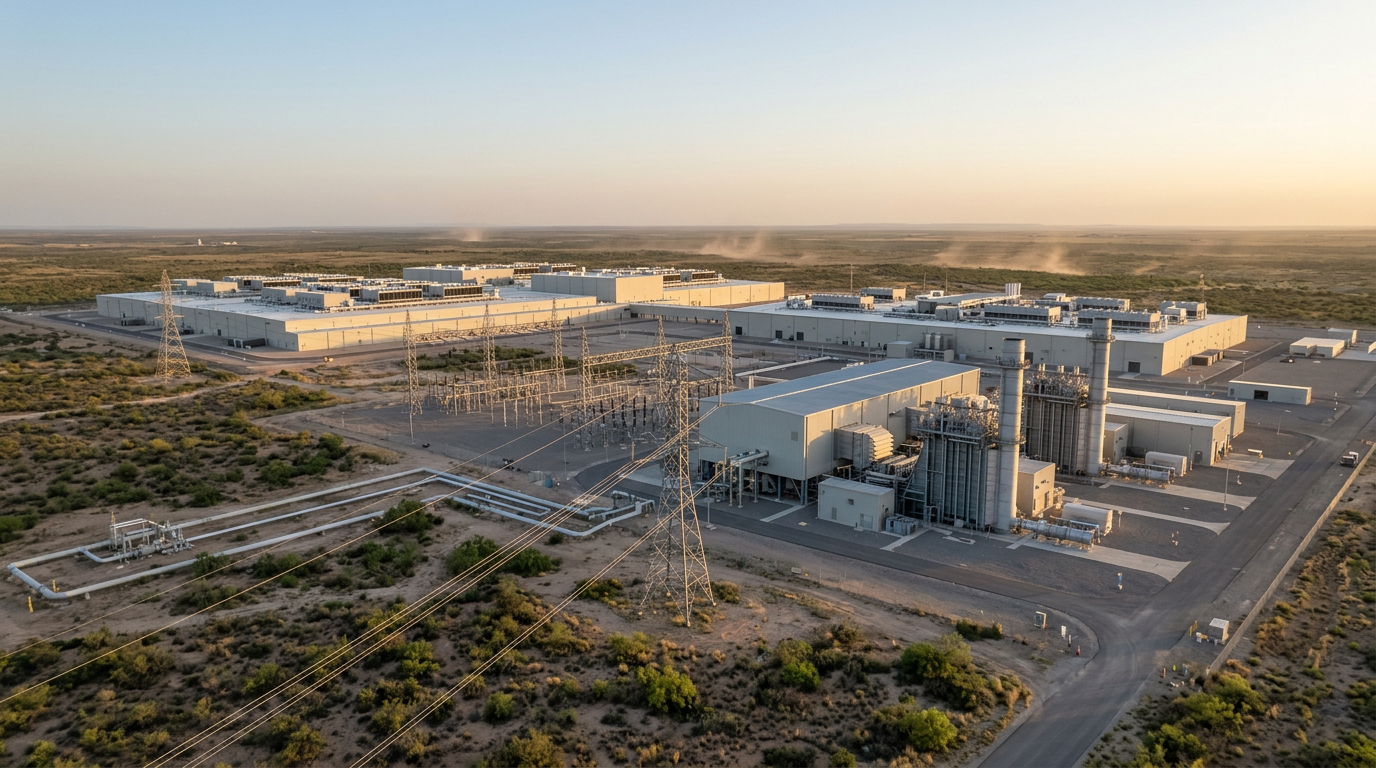
On June 22, Chevron and Microsoft signed a 20-year power purchase agreement for Project Kilby — a 2.67-gigawatt natural gas facility in Reeves County, West Texas that will deliver dedicated, off-grid electricity to one of the largest AI data centers in the United States. The project is estimated at roughly $7 billion in total capital. First power is targeted for 2028. The plant will run independently of the Texas grid, supplying Microsoft directly rather than drawing on ERCOT.
This is not a one-off deal. It’s a signal about where the AI energy trade is actually going — and most of the capital chasing that theme is still pointed at the wrong layer of the stack.
The Physics of the Problem
Here’s the part that gets skipped in most AI coverage. A single data center can consume enough electricity to power 80,000 homes. Hundreds are being built right now, with more announced every week. The U.S. power grid wasn’t built for this. Connecting a new facility to the grid takes years. Permitting timelines run three to five years in most states. The queue for grid interconnection has exploded.
So hyperscalers are going around the grid entirely.
Microsoft plans $190 billion in capital expenditures this year — 61% more than 2025. That number is not going into server racks alone. A material share of it is going into power generation, because without power, the server racks don’t run. The Chevron deal is the clearest articulation yet of what that means in practice: tech companies are building their own power plants, signing 20-year contracts with energy producers, and bypassing the utility system entirely.
Chevron’s edge is specific. Natural gas volumes in the Permian Basin routinely outrun what regional pipelines can carry, forcing operators to flare the excess — a dynamic that depresses local gas prices. Project Kilby draws on Chevron’s existing Permian production. That structural cost advantage is part of why the project is targeting mid-teen returns on capital.
Who Actually Benefits
The immediate read-through on this deal is CVX. The stock rose on the announcement, and the strategic logic is clear: Chevron has found a way to monetize stranded Permian gas at a margin structure that beats commodity pricing. The 20-year contract length eliminates the revenue volatility that makes pure-play energy unattractive to income-focused investors. That’s a meaningful re-rating argument.
But the more interesting trade may sit two levels up the supply chain.
GE Vernova (GEV) is supplying the majority of the turbines for Project Kilby. That’s not a coincidence — it’s a pattern. GEV’s gas turbine backlog and slot reservation agreements reached 83 gigawatts by the end of 2025, up from 62 gigawatts just one quarter earlier. The company raised its full-year 2026 revenue guidance to $44.5 to $45.5 billion after Q1 earnings, citing surging demand from data centers and grid infrastructure. Turbine reservations are on track to be sold out through 2030.
The Power services backlog alone sits at $70 billion. GEV’s Electrification segment — which supplies transformers, switchgear, and power conversion solutions to data center developers — is being asked to double its remaining performance obligation from $30 billion to $60 billion by 2028. Q4 2025 was described internally as the largest hyperscaler-driven order quarter in the company’s history.
Since spinning out of General Electric in April 2024, GEV shares have risen substantially, but the margin expansion story is still early. When GEV was spun out, it carried roughly a 3% earnings margin weighed down by legacy costs. Peers operate near 20%. That gap is closing. Revenue is scaling. The backlog is locked in. The AI energy demand is durable. And now a 20-year contract from Microsoft just validated the exact configuration GEV is selling.
Caterpillar (CAT) is the less obvious read-through. Solar Turbines, CAT’s wholly owned subsidiary, is also providing turbines for Project Kilby. CAT doesn’t get the AI energy story in most coverage — it gets the construction equipment story. But behind-the-meter power generation for data centers is a growing revenue line that the market hasn’t fully mapped into CAT’s industrial earnings power.
The Broader Structural Trade
This is where the story gets bigger than any single deal.
The “bring your own power” trend — where hyperscalers bypass the grid entirely to build self-sufficient data center campuses — is accelerating. Microsoft, xAI, Oracle, and others are all pursuing variations of the same model. The constraint isn’t capital. It’s equipment availability and permitting. GEV’s turbines are effectively sold out through 2030. Caterpillar’s Solar Turbines has a waiting list. Bloom Energy is running at capacity.
What that means: the companies with the manufacturing capacity and contracted backlog to deliver power infrastructure are in a structurally advantaged position for years. This isn’t a cyclical trade on natural gas prices. It’s a multi-year capacity-constrained supply story, with hyperscaler demand as the anchor customer.
Slight tangent worth noting: Microsoft’s willingness to sign a 20-year fossil fuel contract represents a significant strategic shift. The company had aggressive net-zero commitments. The data center buildout is forcing a recalibration of those timelines in ways that make natural gas producers with large existing production bases — Chevron, EQT, Coterra — newly attractive as infrastructure counterparties rather than companies to divest from.
The Options Angle
GEV has been running with elevated IV given its volatility around earnings and order announcements. For traders expecting continued backlog expansion and guidance raises through 2026, call spreads offer defined-risk upside with the Q2 earnings cycle as a near-term catalyst. The risk is macro: if rate fears accelerate and capex commitments from hyperscalers get revised, the backlog visibility compresses faster than the stock reflects.
For longer-horizon investors, the bull case on GEV is straightforward: a company with a $150 billion total backlog, power sold out through 2030, and margin expansion from 3% to a peer-standard 20% still in front of it. That combination doesn’t need a new catalyst. It just needs time.
What the Market Is Missing
Everyone is running the AI trade through semiconductors and cloud. That’s where the attention is. But the physical infrastructure enabling AI — the turbines, the switchgear, the power contracts, the Permian gas that runs the plant that powers the data center that runs the model — that layer of the stack is less crowded and arguably more durable.
The Chevron-Microsoft deal didn’t just benefit two companies. It was a blueprint for who wins the next phase of the AI buildout. The equipment suppliers with locked-in backlog, the energy producers with stranded gas and long-duration contract capability, and the industrial companies that manufacture the hardware the whole thing runs on.
Most of that story still isn’t in the price.
- Stocks to watch: GEV (GE Vernova), CVX (Chevron), CAT (Caterpillar)
- Key data point: GEV’s 83 GW turbine backlog, up from 62 GW one quarter prior — reservations sold out through 2030
- Options consideration: GEV call spreads into Q2 earnings for defined-risk upside on continued guidance raises
- The risk: Hyperscaler capex revision is the single biggest threat to this trade — if Microsoft or Google cut data center spending, the backlog timelines shift
- Longer view: 20-year power contracts with investment-grade counterparties are a new asset class for oil majors — watch for CVX, EQT, and Coterra to pursue similar structures