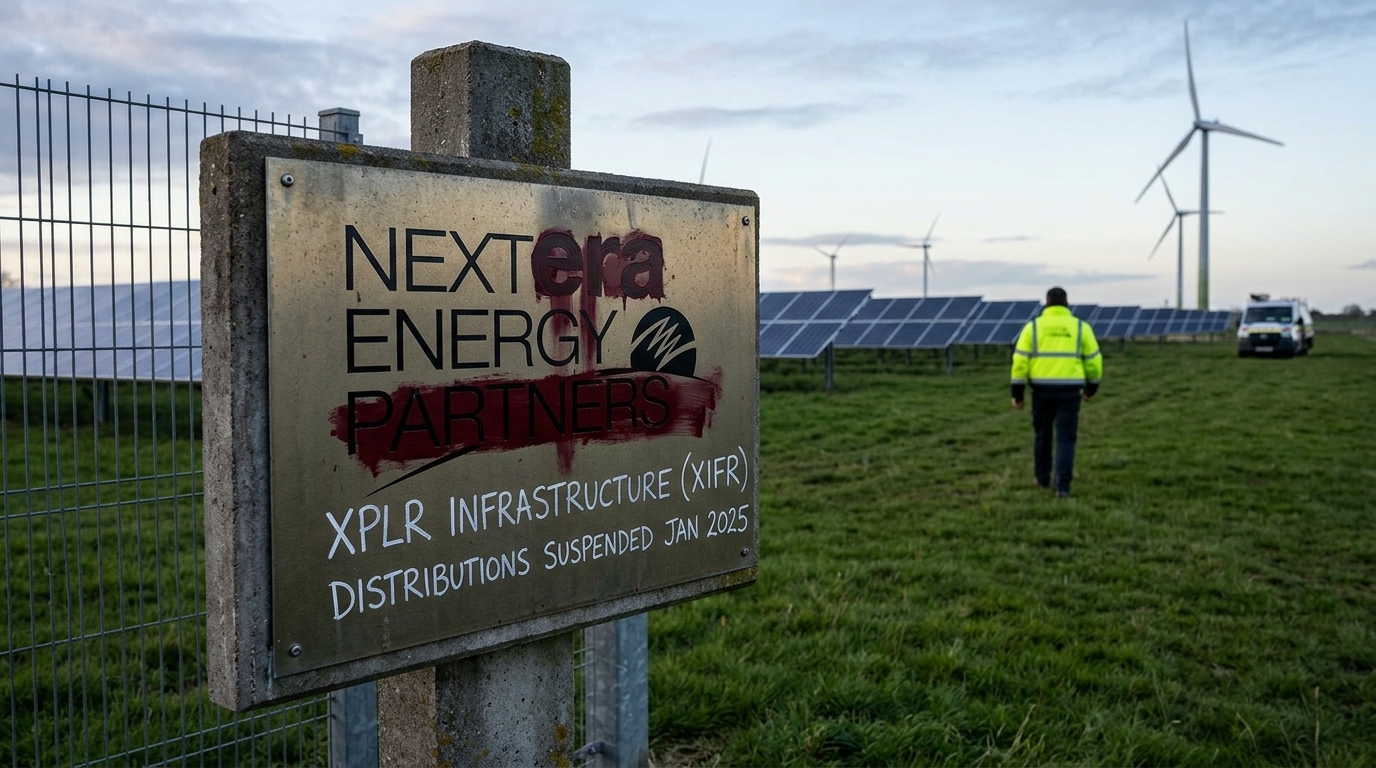
If you have been watching NextEra Energy Partners for its dividend, here is the update that matters: the dividend is gone. The company itself, under that name, is gone too. What trades today under the ticker XIFR is XPLR Infrastructure, a renamed, restructured entity that suspended all distributions to unitholders in January 2025 and has no current plan to reinstate them.
That context is essential, because a lot of income-oriented commentary still frames NEP as a high-yield opportunity. The yield figures circulating online, some above 20%, are an artifact of a suspended payout divided by a share price that collapsed more than 85% from its peak. The double-digit yield figures stem mainly from the plunge in the stock price from its peak, not from any cash being returned to investors now.
The collapse was structural. XPLR had historically relied on outside capital to fund its expansion strategy, initially selling stock to buy income-generating renewable energy assets and gas pipelines from its parent NextEra Energy and third-party sellers. When rising interest rates made equity issuance prohibitively dilutive, that model broke. The company had also layered in convertible equity portfolio financings, complex instruments that could convert to equity stakes in its asset pools if not bought out in cash. Those obligations became a pressure point as rates rose and the unit price fell.
What XPLR is doing now is a genuine restructuring, not a slow fade. In Q2 2026, the company reported adjusted EBITDA of $523 million and free cash flow before growth of $257 million, and completed the first minimum buyout of CEPF 5 and fully repaid $500 million of convertible notes with available cash, further simplifying its capital structure. By Q3 2026, it had completed approximately 85% of its planned 2026 repowerings, sold approximately 400 megawatts of additional interconnection assets to NextEra Energy Resources, and retired the remaining balance of its 2026 unsecured notes.
The underlying asset base is real. XPLR operates a diversified portfolio of contracted clean energy assets, primarily wind, solar, and battery storage projects in the U.S. Those assets are contracted to credit-worthy off-takers with weighted average remaining contract life of roughly 12 years. That is not nothing. The cash flows are durable. The problem has been what sits on top of them.
For 2026, the company expects adjusted EBITDA in the lower half of its prior $1.75 billion to $1.95 billion guidance range and free cash flow before growth at or near the low end of its $600 million to $700 million range, with the revision driven partly by reduced wind resources linked to El Niño weather patterns.
The stock trades near $7 per unit against a market cap of roughly $690 million. GuruFocus’s GF Value suggests the stock is materially undervalued, offering a margin of safety for investors willing to navigate financial leverage concerns. That framing is fair, but the word “investors” here means something specific: patient holders comfortable with no current income, meaningful debt, and a multi-year delevering story.
This is not a yield recovery play. It is a distressed-asset restructuring in a sector with long-term tailwinds. Those are very different things, and the distinction matters before you buy.