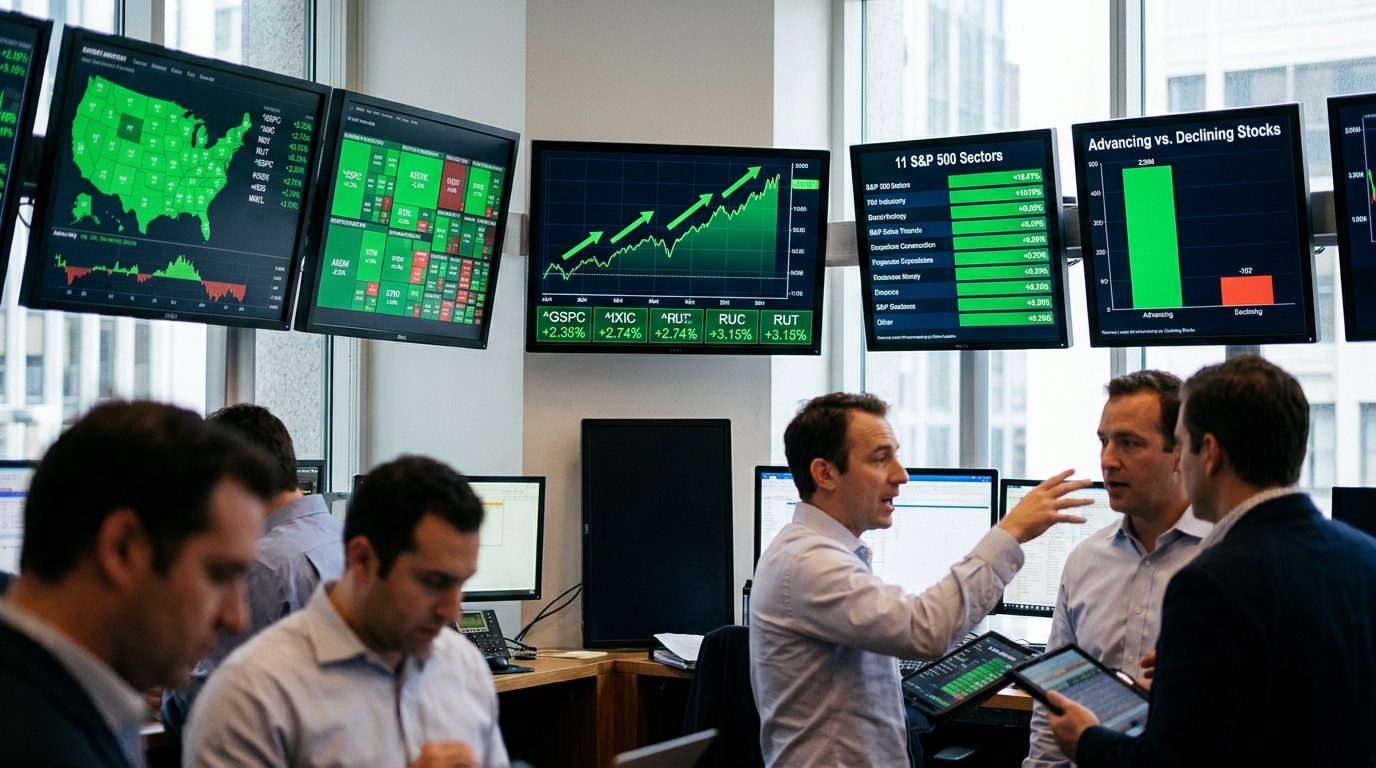
Breadth like Monday’s does not show up on routine days. All 11 S&P 500 sectors rose, and S&P 500 advancers outnumbered decliners by roughly 420 to 79. The S&P 500 rose 2.35% to 7,549.94, its best day since April 8, while the Nasdaq Composite added 2.74% to 25,253.14 and the Russell 2000 gained 3.15% to 2,840.81. When small caps outrun large caps by that margin and every corner of the index advances, the market is usually saying something beyond “dip bought.”
What Actually Moved
Industrials led at +3.82%, technology added 3.73%, consumer discretionary gained 2.92%, and even energy, the lone sector trading in the red through most of the afternoon, finished up 0.52%. Roughly 420 S&P 500 stocks rose and about 79 fell, with 158 gaining more than 3%, the most since August. The equal-weighted S&P 500 matched the cap-weighted index nearly tick for tick, confirming the move belonged to the whole market, not just its heaviest names. The strength came even though Nvidia, one of Wall Street’s most influential stocks, sank.
The VIX fell 22.31%, down 5.72 points to 19.92. That is a meaningful threshold: a VIX above 20 carries a different psychological weight for systematic and volatility-targeting strategies than one below it.
Why It Happened
Oil fell sharply on diplomacy, and on comments from President Trump suggesting fresh strikes on Iran were highly unlikely while talks progress. Lower energy prices reduce the near-term inflation argument and ease cost pressure across industrials and consumer names simultaneously, which helps explain why those two sectors led. AI-infrastructure stocks had tumbled last week on concerns that the Democrats’ success in the midterms might slow the data center build-out. Constellation Energy gained about 10% after beating earnings estimates and raising its full-year guidance, a result that pushed back directly against that fear.
What the Market May Be Missing
Two divergences deserve attention. First, the 10-year Treasury yield closed at 4.88%, up 2 basis points, and the 2-year at 4.56%, up 5 basis points, while stocks rallied. Yields going nowhere, or higher, while equities surge is not the confirmation pattern bulls should want. Second, the VIX and VXN did not fall at the same pace. The VXN minus VIX spread was about 9 points by Monday’s close, because broad market protection cheapened faster than Nasdaq 100 protection did. Options traders were more willing to give up S&P hedges than Nasdaq hedges into today’s inflation data, implying residual concern about the index most exposed to AI and rate sensitivity.
Then there is what arrived Tuesday morning. Fed Governor Christopher Waller said he is leaning toward supporting a quarter-point rate increase in December even if October inflation improves, and said a larger move should be considered if core CPI comes in around 0.3% or higher. That is not the backdrop in which a relief rally typically consolidates.
Where It Shows Up
The PHLX Semiconductor Index jumped about 6.5%. In Tokyo, SoftBank Group surged 13.88%, Advantest rose 4.63%, and Tokyo Electron gained 6.05%, extending the rebound from Friday’s tech-led selloff as AI-related stocks surged. That global coherence matters: when U.S., Japanese, and Korean chip names move together on the same catalyst, the signal carries more weight than any single market’s session close.
Risks and Counterpoints
The week that ended Friday was the S&P 500’s worst since early April 2025. Monday still left it down 0.40% against the October 30 close and 3.4% under its October record high. Two sessions do not erase that damage structurally. Markets are still pricing in a high probability of a December rate hike, and Waller’s remarks this morning suggest even a benign CPI reading would not automatically take tightening off the table. The bull case requires both an encouraging inflation number and a Fed that is willing to look through any residual stickiness. That is a two-variable bet on a single morning’s data release.
What to Watch Next
Today’s October CPI report is the final publicly released inflation reading before the Federal Reserve’s December meeting. Consensus expects headline CPI at 0.3% month over month and core CPI at 0.2%, down from September’s 0.6% and 0.3% respectively. Waller drew a clear line: if core CPI rises around 0.3% or more month over month, a 50-basis-point December hike should be considered. Watch the 2-year yield and the VXN-VIX spread immediately after the 8:30 a.m. release. If yields spike and the spread widens further, Monday’s rally will look more like a one-session reprieve than the start of recovery.