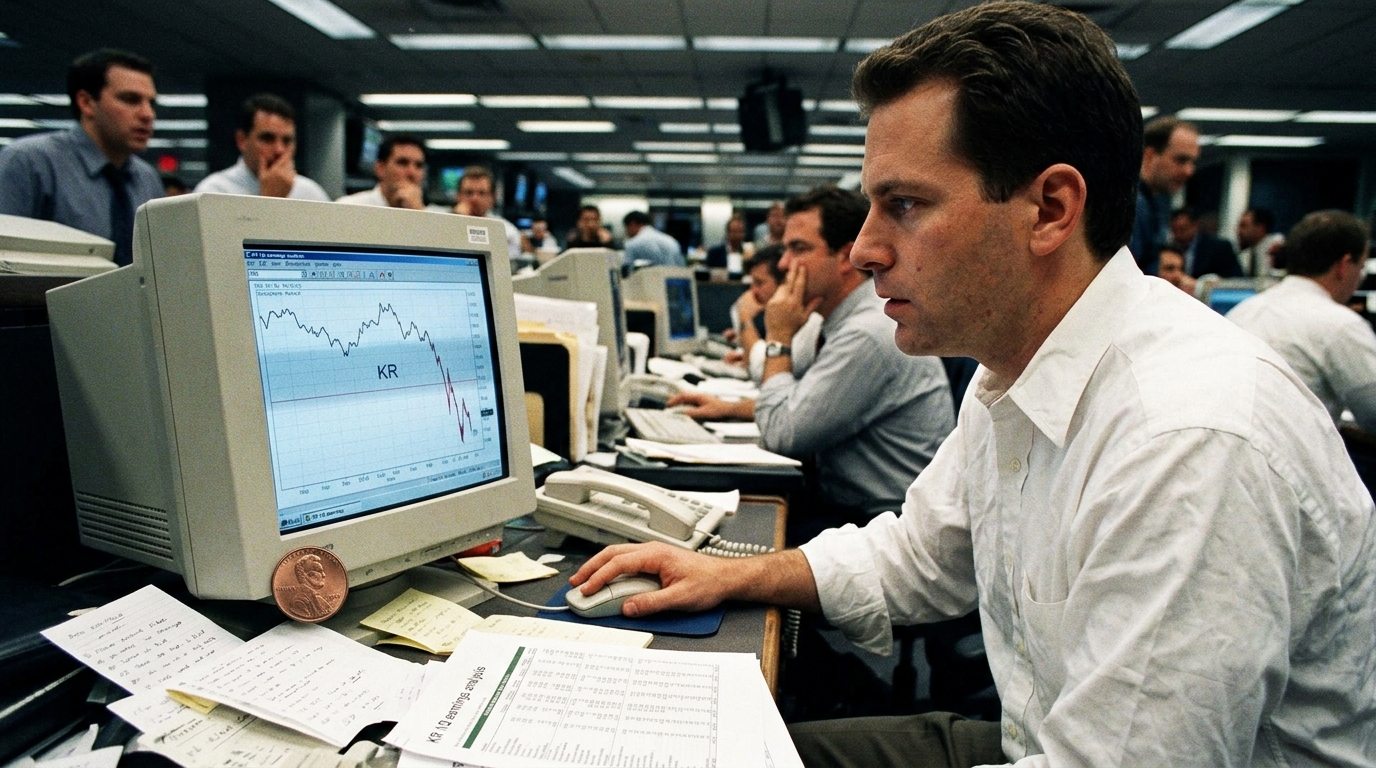
A one-cent earnings miss triggered Kroger’s worst single-day drop in nearly five years. That reaction deserves some explanation – because on the surface, it doesn’t add up.
On June 18, Kroger (KR) reported Q1 2026 results before the open. Adjusted EPS came in at $1.58 against a $1.59 consensus. Revenue of $46.12 billion beat estimates by roughly 1.3%. The company held its full-year guidance unchanged. By the close, shares had fallen more than 8% to a fresh 52-week low near $56.61, the largest single-day decline since September 2021.
The penny didn’t do that. Something else did.
The Real Story: Margins
What markets focused on wasn’t the earnings miss. It was what’s causing the squeeze. Kroger’s FIFO gross margin fell to 22.7% from 23% a year earlier. The company’s net profit margin compressed to roughly 0.68%, compared with approximately 1.8% a year ago. Free cash flow margin dropped to 1% from 2.4% in the same quarter last year. That kind of multi-metric deterioration in a single quarter, for a business that operates on razor-thin spreads to begin with, landed as confirmation of a problem investors had been worried about for months.
The root cause is strategic, not operational. New CEO Greg Foran, who came from Walmart, is deliberately cutting prices on thousands of products to win back shoppers who have been drifting toward Walmart, Costco, and the discount grocers. The logic is defensible. The cost is real. And the market is now trying to figure out whether Kroger can fund those price cuts through savings fast enough to protect profitability – or whether the margin erosion is structural.
Volume told the story clearly. About 9 million shares changed hands on June 18, running roughly 38% above the 90-day average. That kind of elevated turnover on a down day points to deliberate positioning reset, not incidental selling.
The Competitive Context
Slight tangent, but it matters here: the Kroger situation is not happening in isolation. The entire traditional grocery sector is being compressed from multiple directions simultaneously.
Walmart’s scale advantages in procurement and logistics let it absorb price cuts that would be structurally painful for Kroger. Costco’s membership model insulates it from the margin math entirely. Aldi and Lidl are projecting around 2,800 U.S. stores by end of 2026, offering prices 20-30% below traditional grocers and pressuring Kroger’s value perception at the lower end. And Amazon Fresh is chipping away at the digital side. Kroger is fighting a multi-front war with fewer structural advantages than most of its competitors.
Foran’s plan is to fight back through direct sourcing – including more imports bypassing middlemen – better inventory technology, and a scaled-up private label program. The company also reported e-commerce sales growth of 19% in Q1, which is meaningful. But digital still carries lower margins than in-store, so faster e-commerce growth isn’t automatically margin-accretive. Management promised a more comprehensive framework at an investor update scheduled for October 20, 2026. That’s four months away. The market doesn’t love waiting.
What’s Interesting About the Stock Price
KR is now trading 24.8% below its 52-week high of $75.60 reached in March 2026. The consensus analyst price target coming into earnings was around $77. At $56.61, the stock is trading at a steep discount to where most covering analysts had it priced just weeks ago. The question is whether that gap represents an opportunity or a signal that the targets need to come down.
Here’s where I’d push back on the pure bear case: Kroger still generates substantial cash. Revenue of $46.12 billion is not a failing business. The full-year EPS guidance range of $5.10-$5.30 was maintained, implying management believes the savings initiatives can offset the price investment over the next three quarters. The stock trades at roughly 11x that guidance range at current prices – not demanding for a business of this size and stability.
The bull case is essentially this: Foran is executing a classic turnaround playbook that prioritizes volume recovery over near-term margin defense, the savings from direct sourcing and technology start showing up in H2 2026, and the stock re-rates from a distressed multiple back toward historical levels. For value-oriented investors with a 12-18 month horizon, the current price might be pricing in a worse outcome than actually materializes.
Forward Scenarios
Bull case: Price cuts drive same-store sales reacceleration in Q2 and Q3. Cost savings from direct sourcing start flowing through. Margins stabilize. October 20 investor update provides a credible 2027-2028 profit roadmap and the stock recovers toward $70-$75.
Base case: Margins remain under pressure through mid-2026 as price investments continue. Same-store sales growth stays in the 1-2% range. The stock trades sideways between $55 and $65 until the October investor update provides more clarity.
Bear case: Price cuts fail to stop market share losses to Walmart and Costco. Margin compression deepens. Free cash flow deteriorates further. The stock breaks below $50 as investors lose confidence in the turnaround timeline.
What to Watch
- October 20, 2026 investor update – this is the event that matters most. Kroger has promised a full strategic and financial framework, including long-term margin targets.
- Same-store sales trend in Q2. The Q1 figure decelerated to 1% year-over-year from 3.2% the prior year. That trajectory needs to reverse.
- Walmart’s next earnings report. How Walmart discusses grocery market share will reveal whether Kroger’s price investments are actually working.
- Direct sourcing savings timeline. Management has talked about offsetting price cuts through cheaper procurement. When does that show up in gross margin?
- Insider buying. With the stock at multi-year lows and new CEO Greg Foran’s compensation heavily tied to equity, any open-market purchases would be a meaningful signal.
Bottom Line
Kroger’s problem isn’t that it missed by a penny. It’s that the company is in the middle of a margin-for-market-share tradeoff that has no guaranteed ending. The business is large, cash-generative, and not in distress. But it’s competing against opponents who have structural cost advantages it cannot easily replicate. Foran’s bet is that technology, direct sourcing, and private label can close that gap over two to three years. Whether he’s right is the only question that actually determines where this stock goes from here. October 20 is the next real answer.
For informational purposes only.