Not many stocks can drop 41% from an all-time high while simultaneously becoming fundamentally stronger businesses. Constellation Energy is one of them.
CEG hit $412.70 at its 52-week peak. As of July 8, it’s trading near $244. That’s a drawdown that looks alarming in isolation. But the underlying business has undergone a transformation that the stock price hasn’t fully processed yet, and early August earnings are the first real opportunity for the market to reassess.
The Calpine Deal Changes Everything
On January 7, 2026, Constellation completed its acquisition of Calpine Corporation in a cash and stock transaction totaling $21.835 billion, including roughly 50 million newly issued shares. The deal added approximately 23 gigawatts of generating capacity and generated about $11.107 billion of goodwill.
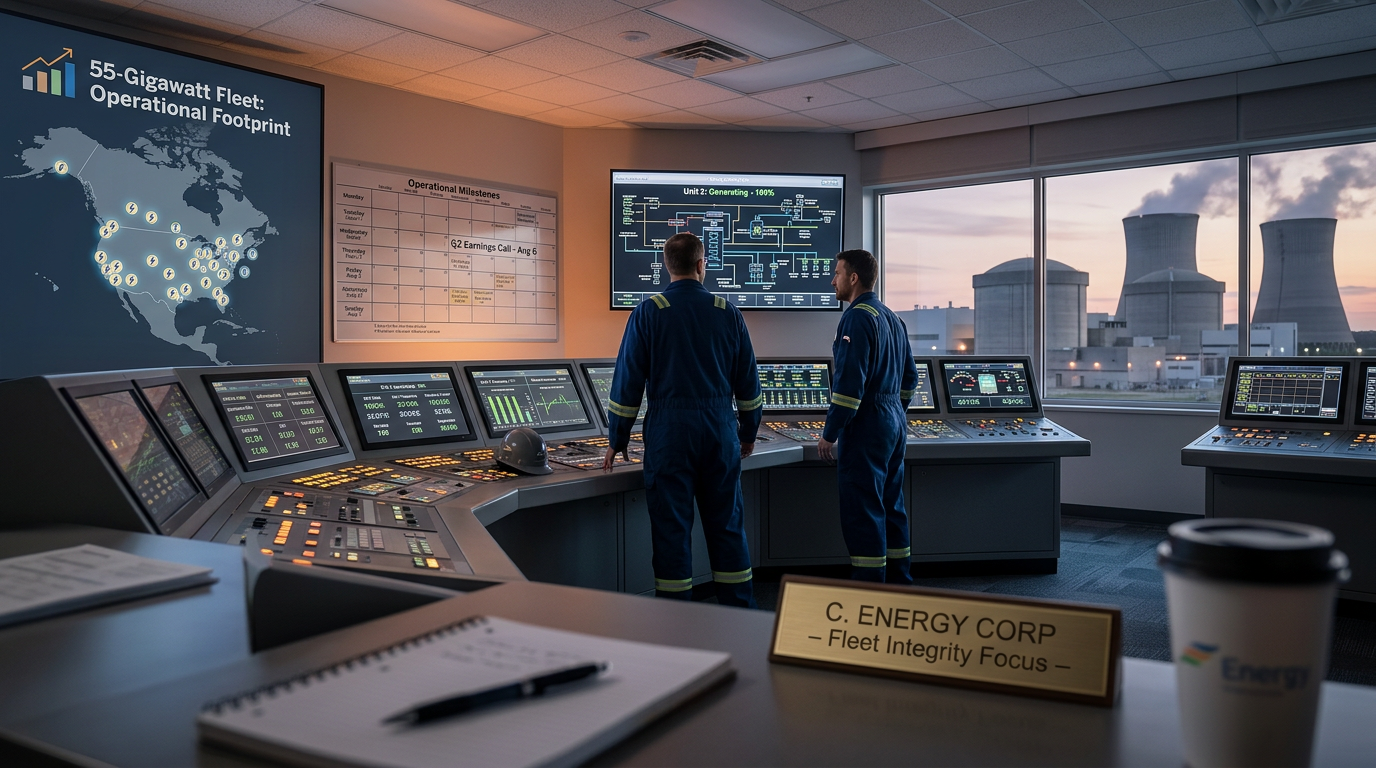
The result: Constellation is now the world’s largest private-sector power producer, operating a roughly 55-gigawatt fleet that supplies approximately 10% of U.S. clean energy and can power the equivalent of 27 million homes.
That fleet includes nuclear, wind, solar, natural gas, and hydroelectric assets. The Calpine acquisition specifically expanded the portfolio with about 23 GW of predominantly natural gas (plus geothermal, storage, and solar assets) capacity, plus a competitive retail platform. This is not a pure-play nuclear story anymore. It’s a diversified clean power platform with institutional-grade scale, signed hyperscaler contracts, and a specific strategy around data center demand.
The Q1 Numbers Tell the Story
Constellation reported Q1 2026 results on May 11. Revenue came in at $11.122 billion, up 64% from $6.788 billion in Q1 2025. Net income attributable to common shareholders hit $1.590 billion versus $118 million a year earlier. Diluted EPS was $4.49, up from $0.38. Operating income rose to $2.332 billion.
Nuclear operations were a quiet standout: Constellation generated about 40 million MWh of nuclear generation at a 92.3% capacity factor (for its operated plants, excluding Salem and South Texas Project output). The company has a 20-year nuclear power purchase agreement with Meta for 1,121 megawatts beginning in June 2027 as part of its long-term contract base.
Management reaffirmed full-year 2026 adjusted operating EPS guidance of $11.00 to $12.00 per share. Free cash flow guidance of $8.4 billion for 2026-2027 rising to $11.5-$13.0 billion by 2028-2029 is the number that matters most for long-duration positioning. That’s an enormous cash generation profile for a company trading near $244.
What the Valuation Implies Right Now
CEG currently trades at a forward P/E of roughly 21x on the Zacks full-year consensus of $11.74 per share. The PEG ratio sits around 0.96, below 1.0, which typically signals the market is not fully pricing in expected earnings growth.
Citi lowered its price target to $297 from $348 on July 1. The consensus analyst target in early July sits in the mid-to-high $300s, implying meaningful upside from current levels if the business executes on full-year guidance. In January 2026, New York regulators extended the state’s zero-emissions credit (ZEC) program to support continued operation of its upstate nuclear fleet through 2049, reinforcing the long-duration revenue visibility that institutional buyers typically pay up for.
What’s interesting is that the stock’s drawdown isn’t fundamentally driven. The pullback reflects broader risk-off pressure around energy and power names, plus ongoing uncertainty around macro and policy headlines. That kind of relative underperformance in a weak tape is where patient traders often find asymmetric positioning.
The AI Power Demand Thesis Is Real
This is the part that ties everything together. Data centers are a large and growing source of electricity demand in the U.S., and that growth is being accelerated by AI workloads.
Four AI hyperscalers collectively plan hundreds of billions of dollars in 2026 capital expenditure. That spending requires electricity, and a lot of it. Nuclear is one of the few carbon-free, 24/7 sources capable of matching that demand profile at scale. Tech giants have been signing nuclear capacity agreements at an accelerating pace.
Constellation sits at the center of all of this. The ‘powered land’ strategy in ERCOT, where the company is effectively co-locating clean power generation with data center customers, is a genuine competitive differentiator.
The Risk Picture
It’s not all clear. The Calpine acquisition added $12.551 billion in assumed long-term debt. Integration execution is a real overhang. Absorbing a large fleet across natural gas and renewables while maintaining best-in-class nuclear reliability is an operational challenge. Any slippage on the nuclear fleet, or adverse regulatory development, would pressure both earnings and the stock multiple simultaneously.
The Calpine lockup also matters: the lock-up period expires on June 30, 2026 for 50% of the shares and on June 30, 2027 for the remaining 50%, introducing potential incremental supply into the market.
Technical Structure
CEG has been trading between $236 and $248 over the past week. The 52-week range sits between $228.63 and $412.70.
The critical technical question is whether $228-$236 holds as a support zone. A break below $228 would put the 52-week low at risk and likely accelerate selling from momentum funds. Conversely, a recovery above $260 would suggest the worst of the post-Calpine dilution pressure has been absorbed and open a path toward the $280-$297 zone near the Citi target.
Scenario Framework
Bull Case: Q2 earnings and guidance updates in early August deliver results in-line with or above consensus. Management reaffirms full-year guidance and provides color on hyperscaler pipeline expansion. Calpine integration commentary is constructive. Stock re-rates toward $280-$297 in the weeks following. New York’s ZEC extension through 2049 is framed as a long-duration tailwind.
Base Case: Q2 earnings are solid but not transformational. Nuclear capacity factor holds near 92%. Debt reduction commentary reassures institutional holders. Stock grinds from current levels toward $260-$270 through August as the Calpine integration narrative matures and sentiment stabilizes.
Bear Case: Q2 earnings show margin compression from integration costs. Nuclear refueling outage days exceed expectations. Debt metrics draw investor concern. CEG tests the $228 low and potentially breaks below it, opening a path toward $210-$215 as risk-off conditions persist.
Active Trader Framework
August 6 is 28 days away. What matters is management’s language on the hyperscaler pipeline, free cash flow progress, and debt reduction trajectory. Those three items, not the headline EPS number, will define how institutional holders digest the quarter.
The setup on risk-reward is unusual. You have a company that just became the world’s largest private-sector power producer, reaffirmed $11-$12 in full-year adjusted operating EPS, and carries a 20-year Meta contract anchoring longer-duration visibility, trading 41% below its peak at a PEG ratio under 1.0. That kind of compression doesn’t mean the stock goes up immediately. It means the asymmetry is worth thinking about carefully before the early August catalyst arrives.
For informational and educational purposes only. Not investment advice. Trading involves risk, including loss of principal.