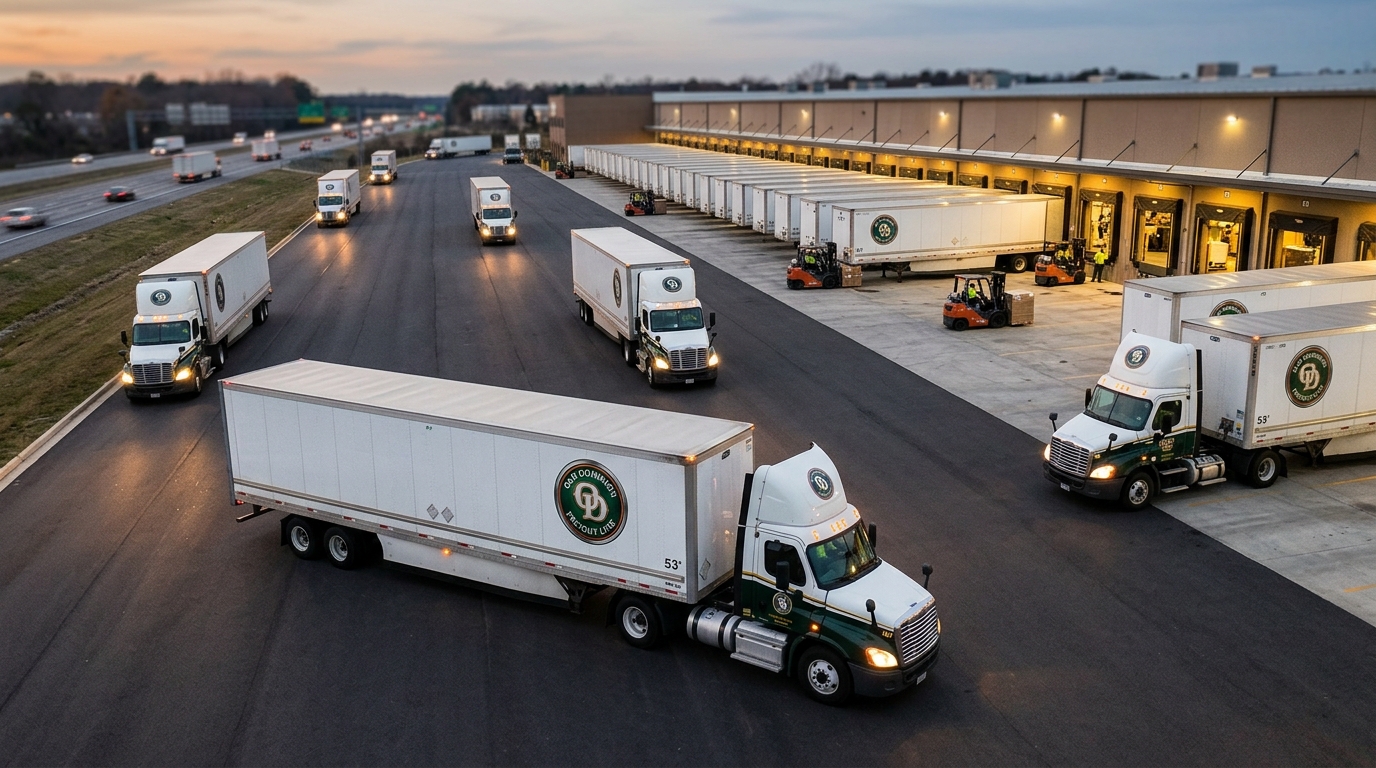
Freight is not a glamorous sector. Nobody is writing breathless threads about less-than-truckload operating ratios. But Old Dominion Freight Line just collected a cluster of analyst upgrades inside a single week, and that kind of convergence tends to mean something — especially when the Q2 earnings date is three weeks away.
Wells Fargo upgraded ODFL to Overweight on July 8, raising its price target to $250 from $235. Evercore ISI had already upgraded the stock to Outperform on July 1, lifting its target to $237 from $219. Stephens resumed coverage with an Overweight rating and a $280 price target, citing a broadly improving transport cycle. That is three separate firms, three upgrades, inside eight days.
Here’s the thing about freight: it’s one of the most reliable leading indicators in the economy. When tonnage turns, it usually means something real is happening in industrial production, retail restocking, or manufacturing output. Evercore’s upgrade explicitly cited a more positive LTL cycle outlook and raised sector estimates — language that matters more than the price target revision.
The May 2026 operating metrics gave them something to work with. Old Dominion reported that revenue per day increased 12.3% compared to May 2025, driven by higher LTL revenue per hundredweight. Tonnage and shipments per day were still modestly negative, but the revenue yield improvement outpaced volume weakness. That is a pricing dynamic, not a demand one. It suggests Old Dominion is maintaining pricing power even before volumes recover.
Q1 2026 was not flattering on the surface. Total revenue came in at $1.33 billion, down about 2.9% from the year-ago period. Earnings per diluted share of $1.14 reflected a freight market still working through a multi-quarter soft patch. But the direction of the May metrics, and the analyst community’s response to them, suggests the inflection point is closer than the Q1 report implied.
Old Dominion’s Q2 2026 results land on July 29. That call is the one that actually matters. It will show whether June volumes built on May’s revenue momentum, whether the operating ratio held up under cost pressure, and whether management is willing to signal recovery in its forward commentary. That combination — volume inflection plus margin stability plus management tone — is what the bulls are betting on.
The Freight Cycle Math
LTL freight is a market structure story as much as a volume story. Since the collapse of Yellow Corporation in 2023, Old Dominion absorbed incremental market share across a customer base that needed a reliable alternative. That structural market share gain did not disappear during the freight softness of 2024 and 2025. It is baked into the revenue per shipment metrics. When volume turns, Old Dominion earns operating leverage on a fixed-cost network it has already expanded to accommodate a larger share of the market.
The operating ratio — expenses as a percentage of revenue — is the metric that separates Old Dominion from peers. Historically, the company has maintained one of the best operating ratios in the LTL industry. In a cycle turn, that ratio typically improves faster at Old Dominion than at competitors because its cost structure and network density are already optimized for higher throughput.
Not everyone is a buyer here. Morgan Stanley downgraded ODFL to Equal Weight around the same time, citing valuation. The stock is trading around $216 to $220, and one analyst’s GF Value assessment puts fair value closer to $184. That tension — strong fundamentals, cycle turn expectations, premium valuation — is exactly the debate that makes the July 29 report so important.
If the Q2 number confirms that the freight cycle has turned, the valuation argument becomes harder to sustain. If it doesn’t, the upgrade cluster looks premature and the stock likely gives back its recent gains.
The part people skip in freight analysis is the options market signal. Heading into a July 29 earnings event with multiple analyst upgrades, elevated expectations, and a stock near its 52-week range midpoint, implied volatility is worth watching. For traders expecting a cycle confirmation, a defined-risk call spread structure limits downside if the report disappoints. For those skeptical of the valuation, a put spread captures the downside if volume recovery fails to materialize.
Freight cycles tend to move in multi-quarter waves. The May data was a signal. July 29 is the answer.